Visit BannerWitcoff.com
Showing posts with label Ubisoft. Show all posts
U.S. Patent No. 9,120,016: Interactive guitar game designed for learning to play the guitar
Issued September 9, 2015, to Ubisoft Entertainment SA


Summary:
In 2008, music rhythm games was a billion dollar industry with Guitar Hero and Rock Band leading the way. Rocksmith was Ubisoft's answer to Guitar Hero and Rock Band. While Guitar Hero and Rock Band only let players pretend to be a rockstar, Rocksmith teaches the player how to play a real guitar by using the instrument as the controller. One of the problems during the development was how to translate the fretboard and chords into an easily understood gameplay interface. U.S. Patent No. 9,120,016 (the '016 Patent) addresses this issues and describes the gameplay mechanics of RocksmithGuitar Hero and Rock Band had addressed this issue by reducing the guitar down to a five button rhythm game, where button icons would travel down a vertical "note highway." Rocksmith took the vertical "note highway" and combined it with a horizontal representation of the fretboard. As notes travel down the "highway," the horizontal fretboard shifts left and right to the corresponding position on the guitar. Since all of the gameplay prompts corresponded with the actual chord positions on the guitar, a player must successfully play the song on a real guitar to succeed in the game.
 
The '016 Patent also describes a system that adjusts to the player's skill and provides methods for the player to improve. If a player struggled with a particular portion of a song, Rocksmith would generate a mini-game related specifically to part troubling the player. The game also provides other forms of feedback to help the player learn how to play the guitar.
 
 
Abstract:
An interactive game designed for learning to play a guitar. A guitar may be connected to a computer or other platform, capable of loading music and displaying notes and chords and other feedback and visual learning aids on a display screen, allowing a user to read music and play along. The goal of the software or interactive game engine is for players to learn how to play a guitar. Users may operate the game in a number of modes with different goals, playing mini-games throughout the levels of the game. The game provides feedback and statistics to help users learn how to play the guitar.
 
Illustrative Claim:
5. An interactive guitar playing system as in claim 1, wherein the notation is presented in a timeline view, the timeline view having notation scrolling from right to left and a video in the background, wherein an audio output of the song is timed to the scrolling notation, and wherein the scrolling notation includes notes or chords that reach a hit area indicating to the user to play the notes or chords within the hit area.

Researched by: Andrew F. Thomas
 
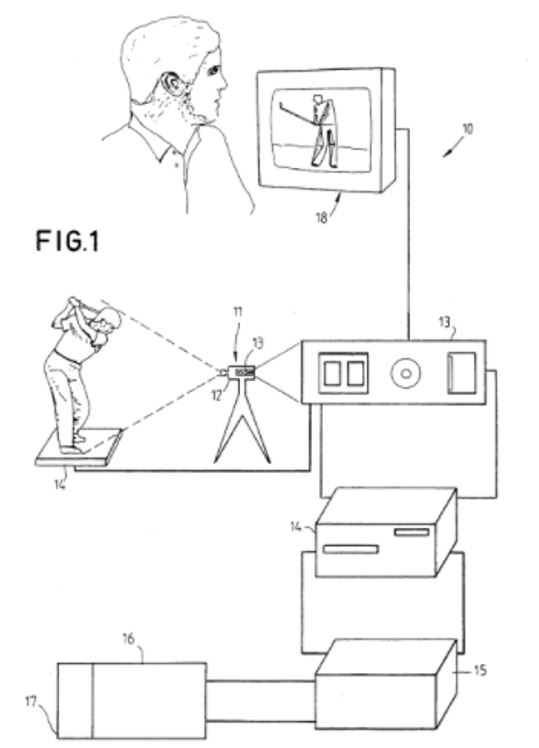
On April 9, 2018, the Federal Circuit ruled in favor of defendants Microsoft Corporation, Ubisoft, Inc., Nintendo of America, Inc., Electronic Arts Inc., Harmonix Music Systems, Inc., and Majesco Entertainment in a patent infringement suit brought by Australian individual Richard J. Baker.   The suit relates to Baker’s U.S. Patent No. 5,486,001, which relates to an instructional aid for movements.  The accused products included video games that incorporated an image capturing device (like a camera) connected to a gaming console or personal computer.


The ’001 Patent reads, in claim 1 and as amended during prosecution:
capturing and storing initial visual image signals representative of a particular movement at a first location,

storing preferred image signals representative of a selected preferred movement at a second location remote from said first location in a data base of a computer,

transmitting said captured and stored visual image signals from said first location to said computer at said second location,

. . .

transmitting said regenerated signals from said computer at said remote second location to said first location and stored in image presentation means which permits viewing thereof with dialogue relating to said regenerated visual secondary image signals.

The Federal Circuit affirmed the district court’s finding that “remote,” as used above, requires “more than physical separation at the same location.”  The Federal Circuit found that this amendment prevented infringement by any of the defendants, both literally and under the doctrine of equivalents.

Cases like these emphasize the importance of careful patent prosecution.  Per the Federal Circuit, the “first location” and “second limitation” language used above was added to traverse a reference (U.S. Patent No. 5,184,295 to Mann).  Little changes like these, which invoke the doctrine of prosecution history estoppel, can have significant ramifications during litigation, as demonstrated here.  It’s game over for Mr. Baker in this case.
On Feb. 8, 2018, Pure Data Systems, LLC (“Pure”) sued Electronic Arts, Inc. (“EA”) and Ubisoft, Inc. (“Ubisoft”) for alleged infringement of U.S. Patent Nos. 5,999,947 to Zollinger et al. and 6,321,236 to Zollinger et al.  


Claim 1 of the ’947 Patent reads:
1. A method of distributing database differences corresponding to change events made to a database table located on a server computer to client copies of the database table located on one or more client computers comprising the steps of:
  creating and storing on the server computer one or more sequentially versioned updates, each update containing database differences in a generic format, the database differences corresponding to database change events made to the database table since the preceding update;
  receiving, from a client computer, a request for all the database differences needed to make the client copy of the database table current;
  determining which updates are necessary for making the client copy of the database table current;
  ascertaining a client database engine type wherein the client copy of the database table is held;
  generating and translating specific database differences, selected based on the necessary updates, into instructions based on the ascertained database engine type prior to transmission; and
  transmitting the specific database differences to the client computer so that the client computer may execute the instructions on the client database engine, thereby making the client copy of the database table current in response to the specific database differences translated into the instructions.
Pure claims that EA and Ubisoft infringe their patents via their “game library updates.”  For example, “if a user purchases a game through the [EA’s] Origin website using a browser, the user’s game library is updated on a server” such that “[w]hen the user next logs into the Origin client, those updates are transmitted to the Origin client running on the user’s computer.”

The lawsuits against EA and Ubisoft are different, likely due to venue issues, but the complaints are almost identical. Pure appears to have also filed similar complaints against Valve Corporation, the Fox News Network, Imgur, CNET, CNN, and Pinterest, among others.  
    Home     Next >

Get the Patent Arcade App

Get the Patent Arcade App
Available now for iOS

Search This Blog


Recognition

Buy your copy today!

Buy your copy today!
ABA Legal Guide, 2d Ed.

Ross Dannenberg

Scott Kelly

Scott Kelly

Labels

Archives

Blogroll

Data Analytics

Copyright ©2005–present Ross Dannenberg. All rights reserved.
Visit BannerWitcoff.com