Visit BannerWitcoff.com
Showing posts with label Patents. Show all posts
U.S. Patent No. 9,616,345: Systems and methods for crowd-sourced game strategy
Issued April 11, 2017, to Electronic Arts Inc.
Priority Date July 1, 2014

Summary:
Playing EA’s Madden can be daunting because of the number of systems and strategies concurrently happening, especially for a person who does not understand American Football. The playcall selection menu can very be confusing to a novice who may not understand the differences between a running play and a passing play. To help the player, Madden will provide suggested playcalls based on the situation, but early incarnations of the suggestion system were all based on pre-programmed suggestions. The game had no way of learning a players habits or adjusting the suggestion based on the opponent. U.S. Patent No.9,616,345 addresses this problem by creating a system and method to collect game play strategy data from online matches and use the data to adjust suggestions accordingly. Now, Madden will provide you suggestions not only based off your previous calls but also what you did in your previous matches as well as how other players handled similar situations. The game will even show you the number of times you have called a play and your success rate. The patent also suggests that this data could be used to alter AI player strategy, but the primary focus of the patent is on playcall suggestions.
Abstract:
Various embodiments provide systems and methods that collect data regarding game strategy decisions by human players during video game, and utilize the collected data to either adjust or replace behaviors of computer players and/or suggest game strategies to human players during video game sessions. The game strategy decisions may be harvested from human-vs-human and human-vs-computer video game sessions. The data may be harvested from online-connected video game sessions, which may be hosted over an online video game network. Depending on the embodiment, the harvested data can include information regarding game strategies used by players during the video game sessions, the game contexts in which the game strategies were respectively used, and the results achieved by the respective use of the game strategies. Systems and methods described herein may facilitate a computer player having behavior that is (at least partially) "crowd-sourced" based on game strategies used by online-connected video game sessions.


Illustrative Claim:
1. A method comprising: as implemented by a processor configured with computer-executable instructions, receiving first data from a first client device, the first data regarding a first game strategy used, by a first game player, in a first game context of a first video game session between the first game player and at least a second game player, the first video game session executing within a video game, the first game strategy being a playcall; updating a game strategy dataset based on the first data, the first data at least including an identity of the first game strategy and an association between the first game context and the first game strategy, the game strategy dataset including a set of one or more previous playcalls used in a set of one or more previous game contexts; receiving gameplay data from a second client device during a second gameplay session, the gameplay data identifying a second game context of the second video game session, the second video game session being between a third player and a fourth player; identifying in the game strategy dataset a set of one or more relevant game strategies based, at least in part, on the second game context during the second video game session, wherein individual game strategies are playcalls available for use within the second video game session; and transmitting to the second client device second data regarding the set of one or more relevant game strategies, the second client device being configured to use the second data to identify at least one suggested game strategy of the set of one or more relevant game strategies for use in the second game context of the second video game session, and generate instructions to output the at least one suggested game strategy within a video game user interface during the second video game session.

Researched By: Andrew F. Thomas
U.S. Patent No. 9,704,350: Musical Combat Game
Issued July 11, 2017, to Haramonix Music Systems, Inc.
Priority Date March 14, 2013

H


Summary: 
Call of Duty: Rock Band. U.S. Patent No. 9,704,350 (the ‘350 Patent) describes a technique for creating a first person shooter game but with the game mechanics of rock band. The ‘350 Patent describes a game like Halo or Call of Duty, but the player has to hit the buttons in time with the music to move around. The patent describes a concept similar to the 2D roguelike rhythm game Crypt of the Necro Dancer. In Crypt, a player moves and attacks in time with the music, but the game is a 2D sprite game reminiscent of the 16-bit era. 

Abstract:
A computerized technique for use with a game console, the technique including providing, using the game console, a combat video game that includes a weapon, providing, using the game console, and an audiovisual system, music as a player plays the video game, analyzing, using the game console, at least one of i) the music, and ii) metadata relating to the music, to determine a property, and controlling the operation of weapon, using the game console, as a function of the property.
Illustrative Claim:
1. A non-transitory computer readable medium including computer readable instructions that, when executed by a computer, cause the computer to: provide a shooter combat video game having an on-screen character with a weapon situated in a virtual world, in which a player controls when the on-screen character triggers the weapon; provide music as the player plays the video game; analyze at least one of i) the music, and ii) metadata relating to the music, to determine a timing parameter related to the music; and cause the on-screen character to fire projectiles from the weapon, wherein firing the projectiles comprises varying a parameter of the projectiles fired from the weapon as a function of the timing parameter.


Researched By: Andrew F. Thomas

U.S. Patent No. 9,707,476: Method for creating a mini-game
Issued July 18, 2017, to Sony Interactive Entertainment Inc.
Priority Date September 28, 2012


Summary:

Classic console games are known for being challenging and lengthy. Developers designed the games for children who could only buy a limited number of games but had all summer to play. Playing a classic game as an adult can be challenging due to time limitations. U.S. Patent No. 9,707,476 (the ‘476 Patent) answers this problem by transforming the classic game into a mini-game that can cover all the classic moments from a game. First, the ‘476 Patent will choose a starting location from the classic or legacy game for which a snapshot is generated. Then an event from the legacy game is chosen and tied to a trigger. Finally, a mini-game script is generated based on the snapshot and chosen event which is sent to the emulator, ready to be played. The patent describes a method for multiple events to be selected with multiple triggers. It is only upon a player hitting a game-ending trigger that the script will send game-ending instructions to the emulator. Potentially, the ‘476 Patent describes a method that would allow a person to play through Final Fantasy 7 in an hour without missing any crucial events in the game.


Abstract:
A starting location for the mini-game is chosen in the legacy game state. A snapshot is generated of that location. Once the snapshot is taken, trigger events are identified. Triggers corresponding to the trigger events are identified. A mini-game script is generated using the snapshot and triggers.


Illustrative Claim:

1. A non-transitory computer readable medium containing executable instructions and data for a mini-game configured to be implemented on an emulator operating on a network, the instructions and data comprising: a) a snapshot of a starting location for the mini-game within a legacy game execution state, wherein the snapshot includes saved data corresponding to the legacy game execution state of every device being emulated by the emulator at a designated time during emulation of a legacy game that the emulator can use to start the mini-game; b) data representing one or more identified triggers that correspond to one or more events within the legacy game; and c) a script for the mini-game generated from the snapshot and triggers.


Researched By: Andrew F. Thomas


U.S. Patent No. 6,488,505: System and method of vehicle competition with enhanced ghosting features
Issued December 3, 2002, to Midway Games West Inc.
Priority Date July 15, 1999


Summary:

U.S. Patent No. 6,488,505 (the '505 Patent) concerns “ghosting” in auto-racing games, a process where a player races against a previously recorded best-effort of a previous player. The '505 Patent is a one of a number of ghosting patents which originated from a mode in the Atari arcade game Hard Drivin’Hard Drivin' was the first car racing game that allowed players to race against a translucent “ghost” recording of a previous race. In this particular patent, if a player finishes a race time fast enough, they are rewarded with free game time. If a player beats the sufficient time to qualify for a free game, this data would be stored in the game along with the finish time and the name of the player. The patent allows the storage of past routes of the cars over which the ghost car travels. By accumulating a plurality of competition scores from multiple past competitions, the game selects one of the scores as the threshold for free game time. The score is calculated according to the ability of the players in the system. Once a player surpasses that threshold, they receive the award.


Abstract:

A system and method for computerized competition useful for rewarding a player. The system and method may be utilized in arcade games, personal computer games, dedicated video games, networked games, and simulators. The method may include selecting a target reward level or threshold such as by selecting a score from a list of past scores, and dynamically adjusting the reward level according to the ability of the players of the system. The method may further include adjusting the playback of a previous competition sequence according to the adjusted reward level. In one embodiment, a previous vehicle race sequence is stored and played back as a ghost or phantom vehicle simultaneously with a present vehicle of a player.


Illustrative Claim:

A simulated vehicle system, comprising: a simulated vehicle configured to traverse a simulated course; a data structure holding a plurality of course finish times; a present course buffer configured to store a present course path of the simulated vehicle and a course finish time of the simulated vehicle as it traverses the simulated course; a recorded course storage configured to store a recorded course path; and a playback adjuster configured to adjust the speed of playback of the recorded course path when a course finish time in the data structure which corresponds to the recorded course path is different than a selected one of the course finish times which is based on an adjusting ratio.


Research By: Rachel Johns
Edited By: Andrew F. Thomas


U.S. Patent No. 5,718,632: Recording medium, method of loading games program code means, and games machine

Issued February 17, 1998, to Namco Ltd.


Summary:

In 1995, Yoichi Hayashi of Namco Ltd. invented a variant of a technique called “Invade-a-Load” which was used in software for the Commodore 64 computer. Namco’s invention was for use with optical disc-based platforms such as the Sony PlayStation. The patent expired on November 27, 2015.

Namco’s patent covered “auxiliary games” that a user can play while the main game is loading. Sony released the PlayStation in 1994. The console had advanced graphics for the time, which it could do by replacing the previous generation’s gaming cartridges with CD-ROMS. However, the PlayStation needed to initialize a game by loading the game data from the disc into the console's memory. The loading process could take several minutes depending on the size of the game, and players would be forced to watch a load screen. Any gamer can tell you that load screens are very dull, especially compared to the instant gratification of cartridge games. The '632 Patent solves this problem by creating a technique for a player to play a smaller game during the load screen. Namco utilized the '632 Patent by allowing Ridge Racer players to play the classic game Galaxian during the load screens. It took no time for the console to load Galaxian, therefore, playing the game would not inhibit the console's ability to load Ridge Racer. Namco made playing Galaxian more than just a distraction since Ridge Race would reward the player with in-game bonuses if he/she could beat Galaxian before the load finished.

  
Abstract: 

A recording medium, a method of loading games program code, and a games machine is provided. The recording medium has a program code relating to an auxiliary game and a program code relating to a main game. The size of the auxiliary game program code is small compared to the size of the main-game program code, and the relationship between the auxiliary game program code and the main-game program code is such that the auxiliary game program code is loaded first, before the main game program code. Unnecessary wastage of time can be prevented by first loading the smaller, auxiliary game program code into the games machine, before the main-game program code is loaded, then loading the main-game program code while the auxiliary game is running.


Illustrative Claim:

1. A recording medium, comprising:

computer readable auxiliary program code means for processing an auxiliary game; and

computer readable main-game program code means for processing a main game, wherein a size of said auxiliary program code means is smaller compared to a size of said main-game program code means and wherein a relationship between said auxiliary program code means and said main-game program code means is such that said auxiliary program code means is always loaded first, before said main-game program code means.


Research By: Rachel Johns
Edited By: Andrew F. Thomas
Groove Digital, Inc. v. King.com, LTD. et al.,
United States District Court for the District of Delaware,
1-18-cv-00836, filed 06/04/2018
 
 
On June 4, 2018, Groove Digital filed a lawsuit in the District Court of Delaware alleging King.com infringed upon U.S. Pat. No. 9,454,762 (the '762 Patent), titled "System and Method for Delivery of Content to a Network Device." Groove Digital claims the '762 Patent relates to push notifications for mobile apps. In the Complaint, King's game, Candy Crush Saga, infringes upon the '762 Patent.

Claim 1 of the '762 Patent reads:
A system for delivering information to a networked device of a user, the system comprising:

a microprocessor running a software application for delivering an applet application to the networked device and managing the delivery of the applet application to the networked device, wherein the applet application passively deploys one or more applets at a time of deployment,

wherein the applet application provides for delivery of content to the networked device and a display of the content in a predetermined portion of a user display that is less than an entire display of the networked device, by the one or more applet, wherein the one or more applet is configured to deploy at least one of independent of or in conjunction with an internet browser window, wherein an internet browser is configured to deploy subsequent to deployment of the one or more applets based on at least one action or inaction of the user, wherein at least one of the applets is configured to become idle upon deployment of the internet browser, and wherein the deployment of the one or more applets is such that at the time of deployment of the one or more applets the user can continue to operate the networked device in a state prior to the deployment of the one or more applets;

a first database coupled to the microprocessor and storing a first set of information relating to the user; and

a second database coupled to the microprocessor and including a second set of information for comparison to the first set of information,

wherein the microprocessor compares the first set of information to the second set of information to determine whether the content should be transmitted to the networked device for display by the one or more applets. ('762 patent, col. 14, lines 9-43).

The '762 Patent has an interesting prosecution history. Samuel Gaidemak and Paul Chacko filed the '762 Patent on March 17, 2006, but the USPTO did not issue the patent until September 27, 2016. During those ten years, the PTO issued eleven office actions against the '762 Patent. On average a patent will face three or four office actions. The more office actions a patent faces, the more prosecution history estoppel the patent acquires, which is used to narrow the patent's claims and restrict the owner's use of the doctrine of equivalents. Groove Digital is asserting the doctrine of equivalents in addition to allegations of literal infringement. King has not yet filed an Answer in response to the Complaint.

Groove Digital is also suing United Bank for infringing the '762 Patent. Normally, we do not report on non-video game related case, but this is the only other lawsuit in which the '762 Patent is asserted. Groove Digital filed the lawsuit against United Bank on December 1, 2017, in the Eastern District of Virginia. The Complaint in that lawsuit alleges that United Bank's mobile banking app infringes the '762 Patent by using push notifications, and the Complaint filed against United Bank is very similar to the Complaint filed against King. United Bank has only filed a motion to dismiss for lack of jurisdiction. These lawsuits against United Bank and King could be the start of Groove Digital suing every mobile app developer that uses push notifications, so it will be interesting to see if Apple takes notice (in view of the integrated push notification technology built into iOS).

We will continue to follow Groove Digital's lawsuit against King and provide updates when available.
On May 22, 2018, Sony Interactive Entertainment LLC (Sony) filed a petition for Inter Partes Review of U.S. Patent 8,206,218 (the '218 Patent), owned by Techno View IP. The '218 Patent is related to a method for displaying stereoscopic images based on how the right-eye and left-eye view the same object. Sony is alleging that the '218 Patent is invalid because it is obvious as a result of prior art.
 
 
Claim 1 of the ’218 Patent reads:
1. A method in a videogame system for displaying three-dimensional images, comprising the computer implemented steps of:

providing left and right backbuffers;

calculating first position coordinates of a first eye view;

storing a first eye view image captured virtually from the calculated first position coordinates of the first eye view of an object in the videogame into the left backbuffer;

determining a second eye view image of the object captured virtually from the calculated second position coordinates of the second eye view;

storing the second eye view image in the right backbuffer; and

displaying the first eye view image and the second eye view image to the user to provide a three dimensional perspective of the object from the videogame system to the user. ('218 patent, col. 13, lines 44-64).
The '218 Patent is related to U.S. Patent 7,666,096 (the '096 Patent), also owned by Techno View and also subject to an IPR petitioned by Sony. Both the '218 and '096 Patents are at the center of a lawsuit Techno View filed against Sony in the Central District of California, in which Techno View alleges that Sony's PlayStation VR infringes Techno View's patents. Sony is using the IPRs to challenge the validity of the allegedly infringed patents. Techno View is also suing Oculus VR claiming their VR system infringes the '218 and '096 Patents. Oculus was not part of the IPR petitions filed by Sony.

This is the third IPR petition Sony has filed this year relating to stereoscopic images. For background on the previous two IPR petitions click here and here.
On January 17, 2018, U.S. District Judge John Michael Vazquez of the District of New Jersey dismissed all patent infringement claims asserted by Joseph Scibetta (a/k/a “Bankers & Brokers”) (“Scibetta”), against Slingo, Inc. and RealNetworks, Inc. (collectively, “Slingo”).  The reason: none of Scibetta’s patents survived scrutiny 35 U.S.C. § 101.

Scibetta is the owner of various intellectual property rights relating to a card and casino game called “BANKERS & BROKERS.”   U.S. Patent No. 6,220,597, one of the patents asserted in the case, describes the game in detail:

1. A method for playing a wagering card game comprising the steps of:
   Providing a shuffled stack of playing cards where the cards are touched only by the dealer during the game comprising at least one deck thereof;
   providing a planar game playing surface comprising a plurality of separately delineated areas adapted for the placement of bets;
   establishing odds for payout of winning bets placed in any of the aforesaid plurality of separated and delineated areas;
   establishing an initial order of play where players are designated as first player, and so on to a last player;
   initiating a round of play by a first player establishing a bet by placing a wager in a designated space on the table near a pot designated and marked onto a surface for displaying a face-up side of a card dealt to each said player;
   dealing a stack of six face-down cards as a player's pot concealing the faces of each dealt card from each player and a dealer, to the first player and any other player in the game;
   dealing a stack of six face-down cards, concealing the faces of each dealt card from each player and the dealer, to the dealer as a dealer's pot;
   then, only the dealer turning the dealer's pot over and turning over the pots over for each player one at a time;
   then the dealer immediately determining a player's winning status or loss status by comparing a face-up card dealt to each player and a now face-up card dealt to the dealer in the dealer's pot;
   after comparing a dealer's face-up card to a player's face-up card, paying any winning bets placed by each player in the game;
   collecting the played or turned up cards from each pot after bets are paid and placing these cards in a discarded cards designated area on the table;
   determining whether the turned-up dealer's card matches the corresponding turned-up player's card, whereby at any time during the game or before the dealer may imposed step of disqualifying and discarding any got touched by a player.

The other asserted patents (U.S. Patent Nos. 6,626,433, 7,331,580, 7,618,044, and 7,857,314) are similar.

Slingo is alleged to have distributed an unlawful copy of BANKERS & BROKERS on their website slingo.com, which was later acquired by RealNetworks, Inc. The alleged copy of BANKERS & BROKERS is reproduced below (as retrieved from archive.org).


On December 12, 2016, Slingo moved to dismiss Scibetta’s case.  Among other assertions, Slingo claimed that all of Scibetta’s patents were invalid under 35 U.S.C. § 101.

The Court agreed. With regard to Alice step one, the Court noted that Scibetta’s asserted patent claims were substantially similar to the “method of conducting a wagering game” patent found invalid in In re Smith, 815 F.3d 816 (Fed. Cir. 2016), cert. denied sub nom., Trading Techs. Int’l, Inc. v. Lee, 137 S.Ct. 453 (2016).  Indeed, the Court noted that “there is no meaningful distinction between, on the one hand, the unpatentable abstract idea found in In re Smith and, on the other hand, the method and system claims here.”  Per the Court, the fact that some claims recited, among other things, a “‘means’ for identifying player/dealer positions” did not “change the fact that [BANKERS & BROKERS] stems from a patent ineligible abstract idea.”

With regard to Alice step two, the Court found that BANKERS & BROKERS “reflects well-understood, routine, and conventional wagering activity” such that “Plaintiffs made no technical improvement on the original abstract idea of a card wagering game using a standard deck of cards.”  The mere implementation of such a game on a computer did not change the Court’s analysis: “the claims do nothing more than simply describe the application of the game-related abstract ideas to a generic computer system.”

Scibetta’s case is not doomed.  Scibetta still has a viable claim for misappropriation against Slingo.  Moreover, while Scibetta’s trademark and unjust enrichment claims were also dismissed by the Court, the claims were dismissed without prejudice and largely based on pleading deficiencies.  As such, Scibetta will be afforded an opportunity to amend and supplement his complaint.

This case illustrates the difficulties of enforcing patents that, despite their presumption of validity, were granted prior to the Alice decision when the USPTO was using a different standard of examination.  A trend is appearing where the presumption of validity applied to those patents by courts appears to be inherently lower than that given to more recently granted patents.  Scibetta asserted five patents, and not one survived a motion to dismiss.  Those looking to acquire patent portfolios, for example, should be particularly wary of purchasing patents which may look great but may face significant hurdles during enforcement.  Sometimes, a single strong patent is worth more than a hundred unenforceable ones.

There's an interesting article in Law360 today about a potential patent dispute surrounding No Man's Sky and the so-call Superformula.  From the article, and of interest to our readers:

Many video games have focused on space exploration; this premise is hardly unique. The novelty with "No Man’s Sky", and the reason for so much excitement and anticipation over its imminent release, lies primarily in the ambitious size of the universe available for exploration in the game. In traditional video game programming, objects that make up the in-game environments must be created individually by writing numerous lines of code into the game for each asset or piece of art — a labor-intensive and time-consuming process limiting the number of objects that can be included in one game.
Hello Games ostensibly avoids these issues by using a programming technique known as procedural generation. Rather than drafting unique lines of code to create each game asset, procedural generation provides a computer with a system of rules and parameters for the game universe, and then relies upon the computer to create in-game assets in accordance with those rules. In other words, each object in "No Man’s Sky" is created not by individual lines of code written specifically for that asset by a programmer, but instead is created by the computer applying algorithms created by the programming team. These procedural rules could cover everything from the way interstellar and spaceship physics work, to the way vegetation looks on planets with particular climates, to the types and behaviors of wildlife. Using this technique, Hello Games has created an in-game universe of unprecedented size and scope, containing 18,446,744,073,709,551,616 accessible planets.[5]
In late July, the media began to report that a company called Genicap had raised the possibility that "No Man’s Sky" might be running afoul of Genicap’s patent rights in the Superformula. The Superformula is a modified version of the equation that describes a circle, and it was discovered by Johan Gielis around the turn of the 21st Century. Changing particular variables within the Superformula causes the equation to describe all manner of geometric shapes and natural forms.[6] Genicap (Gielis’ employer) received U.S. patent No. 9,317,627 (the “‘627 patent”) on April 19, 2016. The ‘627 patent’s primary claim describes the Superformula as “a method for creating timewise display of widely variable naturalistic scenery ... on an amusement device with minimized data storage and processing requirements ... ”
Click the link above for the entire article.  We'll keep you posted of any developments in this area.
White Knuckle Gaming v. Electronic Arts
Case number 1:15-cv-00150
U.S. District Court for the District of Utah


Salt Lake City, Utah.  June 2, 2016.  U.S. District Judge Jill N. Parrish granted Electronic Arts Inc.’s motion to dismiss, saying that Utah-based White Knuckle Gaming LLC cannot sue for patent infringement because the patent at issue — which describes a method for updating sports videos games to reflect real-world changes like statistics, athlete appearances and uniforms — covers an abstract idea and does not include any additional elements that transform the claim into patent-eligible material.

“The patent claims do nothing more than recite the performance of a long-established business practice — rewriting software to produce an updated version — using a general purpose computer and the internet,” Judge Parrish wrote.

“It is a longstanding business practice in the video game industry to update sports video games parameters to reflect real-world developments,” Judge Parrish wrote.

According to Judge Parrish, the patent doesn’t have any additional elements that transforms the abstract idea into an inventive concept because it doesn’t rely on anything other than generic computer equipment in order to be accomplished.

“The court holds that the patent is drawn to a patent-ineligible abstract idea, and merely requiring generic computer implementation fails to transform that idea into a patent-eligible invention,” Judge Parrish wrote.

The patent-in-suit is U.S. Patent Number 8,540,575 titled “Method and System for Increased Realism in Video Games.”  One interesting thing about this case is the length of the claims that were invalidated.  For example, representative claim 1 reads:
1. A game medium configured to provide a sports video game in conjunction with a video game machine, the sports video game including video game rules and video game character parameters, the video game character parameters including video game character performance parameters associated with individual video game characters, the game medium being configured to cause the video game machine to perform a method comprising:
loading video game data stored by the game medium into a random access memory of the video game machine for playing the video game, the video game data including the video game rules and a particular video game character performance parameter associated with a particular individual video game character associated with a particular real-life sports athlete, wherein the particular video game performance parameter is based at least in part on a real-life performance of the particular real-life sports athlete playing in one or more real-life sporting events, the particular video game character performance parameter affecting the manner in which the particular individual video game character performs in the sports video game;
during a single sports season, receiving a series of updated video game character performance parameters from a data server via a network including the Internet, wherein each of the updated video game character performance parameters in the series is based at least in part on one or more different real-life performances of the particular real-life sports athlete in one or more sporting events performed during the single sports season; 
updating the sports video game with each of the updated video game character performance parameters received, wherein each update changes the manner in which the particular individual video game character performs in the sports video game such that the particular individual video game character more closely simulates real-life performance attributes of the particular real-life athlete in the sports video game; and 
enabling a user to control the particular individual video game character in the sports video game using a video game controller connected to the video game machine.
This is a case that will be closely and heavily scrutinized in the wake of Alice v. CLS Bank.  Many practitioners will use this case as more fodder to try to read the tea leaves in the winds of change that is Federal jurisprudence on patent-eligible subject matter.

White Knuckle Gaming will likely appeal.  Along with the McRO case currently pending at the Federal Circuit, this could be another pertinent case in the world of video game patents.
U.S. Patent No. 8,535,153: Video game system and methods of operating a video game
Issued Sep. 17, 2013


Summary:

The ‘153 patent deals with video game systems with two forms of media. The first media contains information about a game and the second media stores information about a particular character. The patent describes a process of swiping cards or selecting characters from an external media source on which an individual character and that character’s attributes are stored. The media is updated with experience, skills, or rewards according to player success in using that character from that media source in a particular game. The patent allows for single or multi- player games that are competitive or cooperative.

Abstract:

Video game systems for executing instructions according to a video game contained on an item of first media including: an item of second media containing data defining an aspect of the video game; and a video game console including a housing, a first media device supported by the housing, a second media device supported by the housing, and a control unit supported by the housing and configured to control the first media device to read the item of first media and to control the second media device to read the item of second media.

Illustrative Claim:

1. A method of operating a video game involving multiple characters playable by multiple players, the method comprising the steps of:
       displaying an environment of the video game on a display screen;
       displaying an icon on the display screen during the video game;
       receiving, by a media device, an input from a first one of the players who provides an item of media after the icon is displayed; and
       attributing a reward associated with the icon with the character being played by the first player.

U.S. Patent No. 8,585,476: Location-based games and augmented reality systems
Issued Nov. 19, 2013

US08585476-20131119-D00000.png


Summary:

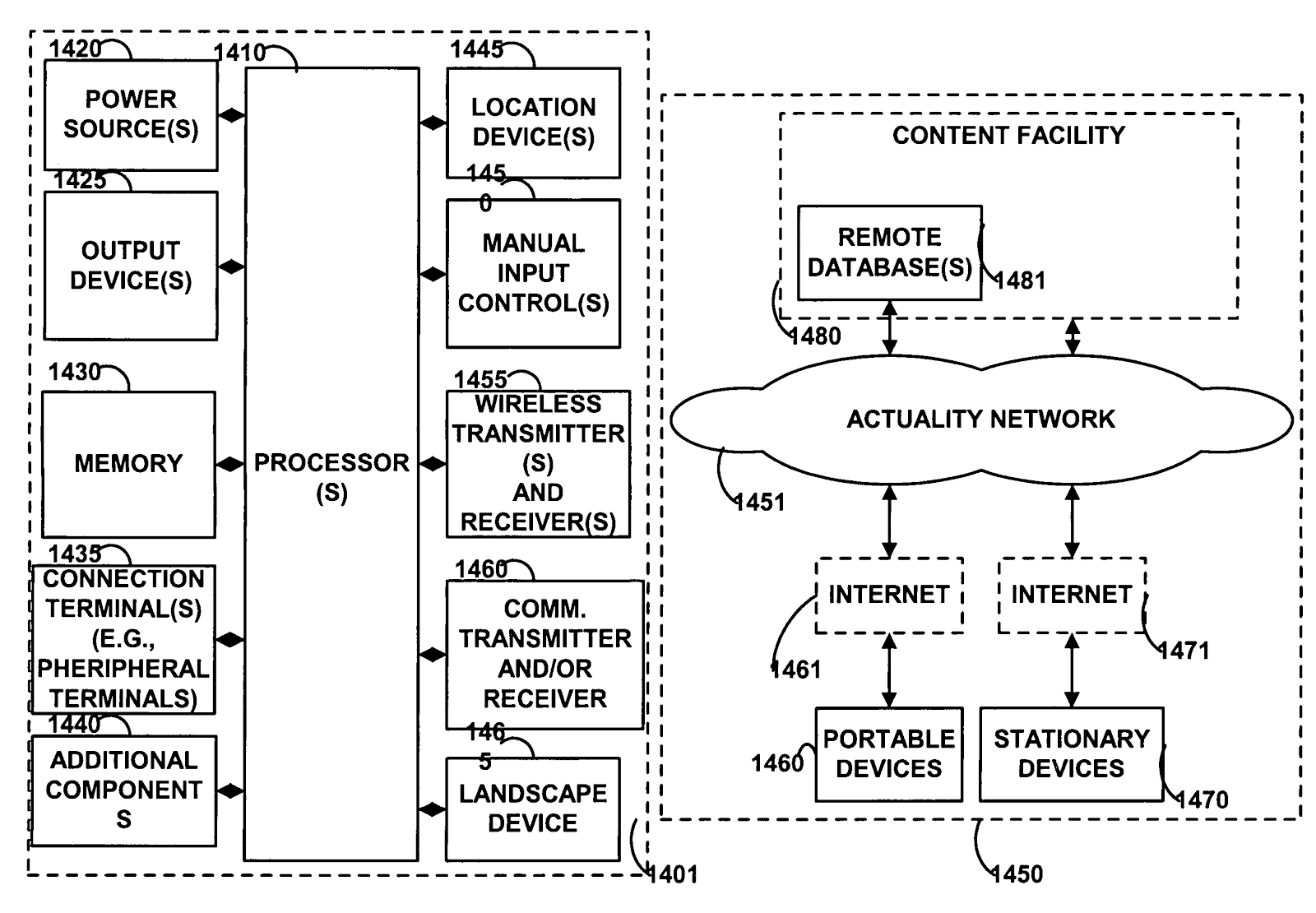
The ‘476 patent deals with virtual realities and augmented realities that rely on real world data to create the virtual world. The player’s location in the real world is tracked using GPS or some other location tracking device, such as a play mat, while the player uses some manner of virtual reality headset. The game uses that location and movement from that data to correlate with location and movement in a virtual world. The augmented reality may rely on visual input from the real world with supplementary elements added by virtual reality. The patent covers both major movements, such riding in a driving a car or traversing a field, and minor movements, such as hand movements.

Abstract:

Handheld location based games are provided in which a user's physical location correlates to the virtual location of a virtual character on a virtual playfield.

Augmented Reality (AR) systems are provided in which video game indicia are overlaid onto a user's physical environment. A landscape detector is provided that may obtain information about the user's landscape, in addition to the user's location, in order to provide overlaying information to an AR head-mounted display and control information to non-user controlled video game characters.

Illustrative Claim:

1. An augmented reality game system comprising:
      a head-mounted display that overlays virtual indicia onto a physical playfield;
      memory comprising video game logic that provides a video game;
      a wearable processor that utilizes said video game logic to provide video game indicia to said head-mounted display based on said video game logic, wherein said processor is coupled to said memory and said head-mounted display;
      a detector that determines landscape characteristics of said physical playfield, wherein said video game logic utilizes said landscape characteristics in providing said video game; and
      a locating device that determines the physical location of said locating device on the physical playfield, wherein said video game logic utilizes the physical location of said locating device in providing said video game.
U.S. Patent No. 8,678,891: Video game systems and methods including protecting game character(s)
Issued March 25, 2014


Summary:

The ‘891 patent applies to multi-player games, in which each player controls a separate character. A player may input a command that protects that player’s character from harm, shown by a visual indicator, such as a bubble around the character, on the screen. Once a character is protected, the player loses control of the character, and the character moves according to the action of the other, unprotected characters, for example due to the scrolling of the screen. Certain conditions remove the character’s protection, returning that character to control through player input.

Abstract:

Example systems and methods relate to a video game in which multiple players each supply inputs to a respective input device to control a corresponding game character in a game world. Movements and actions of each game character are controlled in accordance with a first game character control operation during the playing of the video game. If one or more conditions is satisfied by one of the players, the one player's game character is protected from harm in the gameworld. Movements and actions of the protected game character are controlled in accordance with a second game character control operation. The protecting of the one player's game character is stopped in response to one or more protecting stopping conditions, whereby the game character is again controllable in accordance with the first game character control operation. If all game characters are protected, current playing of the video game ends.

Illustrative Claim:

1. A method comprising:
       while playing a multi-player video game in which multiple players each supply inputs to a respective input device to control a corresponding game character in a game world displayed on a display screen, controlling movements of each game character in the game world in accordance with respective first game character control operations during the playing of the multi-player video game;          in response to satisfaction of one or more conditions, protecting the one player's game character from harm in the game world; controlling movements of the protected game character in the game world; stopping the protecting of the one player's game character in response to one or more protecting stopping conditions, whereby the movements of the one player's game character in the game world are controllable in accordance with the first game character control operation for that game character; and if all game characters are protected during the playing of the multi-player video game, causing current playing of the multi-player video game to end.
U.S. Patent No. 8,668,561: Video games including real-life attributes and/or fantasy settings
Issued Mar. 11, 2014


Summary:

The ‘561 patent applies to fantasy sports and covers a networked system that creates a video game sports team based on at least part of a fantasy team roster.  The system includes a server so the game team based on the fantasy roster can be used in online gaming or updated as the fantasy roster is updated. The real life actions of players on the fantasy team roster impact the play of the video game team during console play.


Abstract:

A video gaming console and related network interfaces with a server computer hosting an online fantasy sports game. The video game machine acquires a fantasy team roster of the fantasy sport game over a network that includes the Internet and the video game console is programmed to create a video game team using at least a portion of the fantasy team roster. The video game team created is playable on the video game console.


Illustrative Claim:

1. A method performed by a computer server for updating a video game team roster in a sports video game played on a video game console, the computer server configured to communicate with a plurality of video game machines via a network connection that includes the Internet, the method performed by the computer server comprising the following acts:
hosting an online fantasy sports game on the computer server configured to communicate with the plurality of video game machines via the network connection that includes the Internet, the online fantasy sports game including:
a plurality of fantasy sports teams that are each operated by a fantasy team owner in a fantasy sports league;
each fantasy sports team having a fantasy team roster comprised of fantasy team members, wherein the fantasy team members are associated with real-life athletes of collegiate and/or professional sports teams and the fantasy team members of each fantasy team are selected by the fantasy team owner of each fantasy team through a fantasy draft; and
wherein the online fantasy sports game provides a score for each fantasy sports team in the fantasy sports league, the score being calculated using statistics from a real-life performance of the real-life athletes associated with the member of each fantasy sports team; and
transmitting a fantasy team roster associated with a particular fantasy team to the video game console, wherein the video game console is programmed to create a video game team including a plurality of video game characters corresponding to at least a portion of the members of the fantasy team roster to be played in the sports video game on the video game console, wherein the video game characters of the video game team are associated with the same real-life athletes that are associated with the fantasy team members of the fantasy team roster transmitted, wherein the fantasy team owner is not one of the real-life athletes engaging in the real-life sporting events who are associated with the fantasy team members.

U.S. Patent No. 8,690,653: Video game systems and methods
Issued Apr. 8, 2014, to Nintendo Co., Ltd.


Summary:

The ‘653 patent covers multiplayer games in which each player controls a separate character and, under certain conditions, a character may become invincible. Each player uses a separate controller. While a character is invincible, the character responds to a different control scheme than when a character is susceptible to damage.


Abstract:

Example systems and methods relate to a video game in which multiple players each supply inputs to a respective input device to control a corresponding game character in a game world. Movements and actions of each game character are controlled in accordance with respective first game character control operations during the playing of the video game. If one of a plurality of conditions is satisfied by one of the players, the one player's game character is protected from harm in the game world. Movements and actions of the protected game character are controlled in accordance with a second game character control operation. The protecting of the one player's game character is stopped in response to one or more protecting stopping conditions, whereby the game character is again controllable in accordance with the first game character control operation.


Illustrative Claim:

1. A method comprising:
while playing a multi-player video game in which multiple players each supply inputs to a respective input device to control a corresponding game character in a game world displayed on a display screen,
controlling movements of each game character in the game world in accordance with respective first game character control operations during the playing of the multi-player video game;
in response to satisfaction of any one of a plurality of conditions by one of the players, protecting the one player's game character from harm in the game world, wherein the plurality of conditions include both voluntary conditions based on the one player's inputs and involuntary conditions automatically imposed by the multi-player video game;
controlling movements of the protected game character in the game world; and
stopping the protecting of the one player's game character in response to one or more protecting stopping conditions, whereby the movements of the one player's game character in the game world are controllable in accordance with the first game character control operation for that game character.

U.S. Patent No. 8,715,087: Video game including user determined location information
Issued May 6, 2014


Summary:

The ‘087 patent covers a method and device, which work together to collect player selected GPS information then use that information in the creation of some elements of a game world. The created elements may be derived from real world video or from other stored information. The game world is mapped over the selected GPS location.


Abstract:

A method, apparatus and computer program product for a video game including user determined location information is presented. Location information (e.g. GPS, Google Maps, an entered address or the like) determined by a user of a video game is acquired. Then user determined location information relating to a physical location determined by the user is mapped to a video game environment wherein the user of the video game experiences objects from the users entered location while playing the video game.


Illustrative Claim:

1. A computer-implemented method comprising:
receiving information about a real world physical location for a user of a videogame;
obtaining user determined location information relating to said real world physical location determined by said user, said user determined location information comprising continuous pre-recorded actual video of said real world physical location and of an area surrounding said real world physical location; and
mapping said user determined location information into a video game environment wherein the user of said video game experiences objects from the entered real world physical location, wherein said user traverses said video game environment while playing said video game, wherein said user of said video game is stationary in said real world and wherein all images acquired from said continuous pre-recorded actual video remains exactly as presented in the real physical world into the video game.

U.S. Patent No. 8,721,412: System and method configured to unlock content within a videogame
Issued May 13, 2014, to Activision Publishing, Inc.


Summary:

The ‘412 patent covers both single and multi-player video games. The games covered have different content sets, or quests, that can be completed by any combination of a single player, other real world players, and artificial intelligences. The player can move between these content sets, interact with the players therein, and complete discrete goals.


Abstract:

A system and method are configured to provide a videogame to one or more players. The videogame may involve a series of different sets of content within which players perform activities. A group of players may be associated with the content sets. The players may include virtual players controlled by artificial intelligence and one or more real world players. Players may progress through the videogame by moving from content sets to content sets, performing objectives in the various content sets, and interacting with the players within those content sets.


Illustrative Claim:

1. A system configured to provide a player with a videogame, the system comprising:
a game platform configured to implement one or more computer program modules to provide a player with the videogame, the one or more computer program modules comprising:
a content module configured to manage multiple sets of content within the videogame, wherein the multiple sets of content within the videogame comprise a first content set that is accessible to the player engaging in the videogame and a second content set that is not accessible to the player initially within the videogame, wherein the second content set is associated with a first set of criteria, wherein the content module is configured to unlock the second content set within the videogame for the player to enable the player to access the second content set within the videogame responsive to the player fulfilling the first set of criteria, wherein the first set of criteria includes performance of one or more tasks provided by the first content set that are not sufficient to pass the first content set, successful participation in one or more events associated with the first content set, and achieving a first disposition mode for a social relationship between the player and one or more virtual players in the videogame, and wherein the first content set and the second content set must be passed to complete the videogame; and
an event module configured to manage a first set of events associated with the first content set, and to determine if the player has successfully participated in individual events in the first set of events, and wherein the first set of criteria associated with the first content set requires successful performance of some subset of the first set of events as determined by the event module.

U.S. Patent No. 8,740,707: Video game controller for multiple users
Issued Jun. 3, 2014


Summary:

The ‘707 patent is a hardware patent, which covers a game controller that can be used by two or more players cooperatively. The controller senses real world movement and converts these signals into information that can control game play. The controller relies on conductive materials to sense how many players are using the controller and in which ways.


Abstract:

The present invention provides a video game controller and apparatus that may be used by two or more players. The users physically manipulate the control device cooperatively to the kinesthetic feedback of the other player(s) to control the events of the video game. By working together through orientation of the controller, the players can jointly move the video game object on the screen and/or govern the play of the game.


Illustrative Claim:

1. A video game system for cooperative play by two or more players comprising:
a first conductive material attached to or in contact with a first player's body and a second conductive material attached to or in contact with a second player's body;
a microcontroller in communication with the first and second conductive materials, said microcontroller further being in communication with a computer processing unit (CPU) or a game console;
whereby skin of the first player touching skin of the second player closes a circuit between the first and the second conductive materials and the microcontroller, said circuit closing causing the microcontroller to send a signal to the CPU or the game console thereby causing said CPU or gameconsole to display a video game having at least one game object that responds in accordance with the signal.

    Home     Next >

Get the Patent Arcade App

Get the Patent Arcade App
Available now for iOS

Search This Blog


Recognition

Buy your copy today!

Buy your copy today!
ABA Legal Guide, 2d Ed.

Ross Dannenberg

Scott Kelly

Scott Kelly

Labels

Archives

Blogroll

Data Analytics

Copyright ©2005–present Ross Dannenberg. All rights reserved.
Visit BannerWitcoff.com