Visit BannerWitcoff.com
Showing posts with label Nintendo. Show all posts
U.S. Patent No. 8,858,328: Storage medium having game program stored therein, hand-held game apparatus, game system, and game method
Issued October 14, 2014, to Nintendo Co., Ltd.
Priority Date June 2, 2010


Summary:
U.S. Patent No. 8,858,328 (the '328 Patent) describes a game that uses real pictures as the basis for the puzzle. Using the Nintendo DSi, the player takes a picture that the system converts into the puzzle. The system divides the image into sections assigning each section a number. The numbers corresponded to the sections' original location. Once the system determines the starting points, it shuffles the sections. The player must rearrange the picture sections to their original position to complete the puzzle. Players can adjust the difficulty by increasing the number of sections.


Abstract:
An information processing section of a game apparatus executes a program including: a step of setting a puzzle area to be cut from an image taken by an outer camera; a step of setting the division number representing the number of portions into which the puzzle area is divided in accordance with a stage; a step of generating one-dimensional arrangement data representing a state in which puzzle pieces are positioned at random: a step of executing a game process by updating the one-dimensional arrangement data of the puzzle pieces which are selected based on a tilt of the game apparatus; and a step of switching, in accordance with the one-dimensional arrangement data, texture coordinate data of the puzzle pieces calculated based on a tilt of a virtual camera, and displaying an obtained image.


Illustrative Claim:
1. A non-transitory computer-readable storage medium having stored therein a game program executed by a computer of a hand-held game apparatus including an imaging device and a display device, the game program causing the computer to perform at least: sequentially acquiring taken-image data representing a plurality of taken-images which are taken by the imaging device; image dividing, into a plurality of small areas, an image of a predetermined area in a taken-image which is one of said plurality of taken-images represented by the acquired taken-image data; positioning, in the predetermined area, the plurality of small areas into which the image of the predetermined area is divided, so as to form an image different from the taken-image which is taken by the imaging device and is one of said plurality of taken-images; retaining a positioning state in which the plurality of small areas are positioned, by using, as an initial value, an obtained positioning state; image changing for sequentially changing, by using the taken-image data having been sequentially acquired, images to be displayed on the plurality of small areas, respectively, of which the positioning state is retained; display control for causing the display device to display images changed by the image changing; changing the positioning state of the plurality of small areas, which is retained, in accordance with an operation performed by a user viewing the images displayed by the display device; determining whether or not the positioning state of the plurality of small areas, which is changed, satisfies a predetermined condition; and a game process for performing a predetermined game process in accordance with a result of a determination of whether or not the positioning state of the plurality of small areas, which is changed, satisfies a predetermined condition.


Researched By: Andrew F. Thomas


U.S. Patent No. 8,882,590: Touch-controlled game character motion providing dynamically-positioned virtual control pad
Issue November 11, 2014, to Nintendo Co., Ltd.
Priority Date April 28, 2006


Summary:
U.S. Patent No. 8,882,590 (the '590 Patent) describes a method to control a game through touch controls. The '590 Patent relates to the Nintendo DS and its touch screen. On the DS, a player could move a game character by touching the bottom screen. If the player wanted the character to move to the right, he would first need to touch the screen then move his finger or the stylus to the right. At the first point of contact, the system divides the screen into multiple zones around that point of contact. Each zone indicates a direction, so when the player moves his finger to the right, the system moves the character to the right.  


Abstract:
Methods and apparatus for controlling movement of a digital object displayed on a screen provide a virtual dynamic direction control pad based on zone detection and touch stroke direction to control customized animated character motion. A player wishing to move the digital object can use a stylus or other touch to indicate a first point on the screen. When the player first touches the stylus to the screen, the system analyzes the touch and divides the screen into multiple zones around the first point indicated by the player. To move the object, the player moves the stylus to a second point on the screen. Movement of the stylus to a second point within one of these zones causes the digital object to perform a predetermined action. Each zone has a predetermined associated action. Direct control of character motion by the game player is enhanced.


Illustrative Claim: 
1. A method of controlling movement of a moveable digital object displayed on a touch screen that is coupled to at least one processor, the method comprising: displaying the moveable digital object on the touch screen; using a touch to the touch screen to select the moveable digital object and indicate a first touch point on the touch screen corresponding to the displayed digital object; automatically dynamically dividing, using the at least one processor, the screen into plural virtual zones that (1) are associated with the first touch point, and (2) emanate from a neighborhood determined in accordance with the selected moveable digital object; detecting a further touch to at least a second touch point on the touch screen different from the first point; determining, using the at least one processor, in which of said automatically divided plural virtual zones said second touch point is disposed within to thereby select one of said plural virtual zones; and controlling, using the at least one processor, the movable digital object to perform an action that moves the movable digital object based at least in part on said which of said determined virtual zones is selected by said second touch point.


Researched By: Andrew F. Thomas

U.S. Patent No. 8,313,379: Video game system with wireless modular handheld controller
Issued November 20, 2012, to Nintendo Co., Ltd.
Priority Date: August 22, 2005


Summary:
U.S. Patent No. 8,313,379 describes the Nintendo Wii system. The Wii incorporation of motion controls into a video game system. Motion controls were not a new concept in video games, but the Wii certainly push motion controls into the mainstream. The Wii utilized a small remote and IR sensor bar to track a users movement. The IR sensor bar would be place usually on top of or below the television. A user would point the Wii remote in the direction of the television/sensor bar, and the Wii would generate a cursor on the TV in the corresponding area. When the user moved the remote, the cursor would follow. The Wii remote used accelerometers and infrared detection to determine its position in 3D space when pointed at the sensor bar. Calculating position in a 3D space is essential for games that require movement along a Z axis, such as a boxing game. Despite the complexity it took to track a user's movement, the motion controls were simple to understand. 

The Wii was a hugely successful console for Nintendo, selling around 100 million units. A big reason for the Wii's success was the accessibility. The motion controls made playing video games simple for the non-gamer. A person could easily understand that to play a golf game only required swinging the Wii remote like a golf club. The Wii had a significant impact on the video game industry. Shortly after the Wii launched, Microsoft and Sony introduced their versions of motion controls. Nintendo still uses a form of motion control in its current system, the Nintendo Switch, though the system does not require motion controls to operate. 


Abstract:
A home entertainment system for video games and other applications includes a main unit and handheld controllers. The handheld controllers illumination emitted by emitters positioned at either side of a display, and information derived from the sensed illumination is used to calculate the orientation of the controllers. The controllers can be plugged into expansion units that customize the overall control interface for particular applications including but not limited to legacy video games. Further, the controllers can be used in one-handed or two-handed modes of operation.

Illustrative Claim: 
1. A handheld controller operable in a one hand mode of operation and a two hand mode of operation, said controller for use in wirelessly communicating with an electronic game machine having an associated display screen, a first light emitting marker and second light emitting marker each mounted spaced from, but in the vicinity of, the display screen, said handheld controller comprising: an elongated housing having an upper surface, a lower surface, a forward end, a rearward end and a longitudinal axis defining at least one longitudinal center line, and sized to be operable by one hand of a user; a first set of game controls proximate said forward end of said housing; a second set of game controls proximate said rearward end of said housing; said first set of game controls and said second set of game controls being operable in use in a two hand game playing mode of operation, wherein during said two hand game playing mode said first set of game controls are disposed so as to be actuated by one thumb of a user and said second set of game controls are disposed so as to be actuated by the other thumb of the user, and wherein said first and second sets of game controls are actuated in use by the cooperative action of the user's thumbs; the lower surface of said housing having a concave portion provided with a trigger switch; a processor enclosed within said housing; an imaging device located in said forward end of said housing at least substantially aligned with said longitudinal center line and including a filter, a lens, an image sensor and an image processing circuit, wherein the image sensor, in use, detects light from the first light emitting marker and the second light emitting marker and generates image data, and wherein the image processing circuit, in use, receives and processes said image data and generates position data related to positional coordinates of the first light emitting marker and the second light emitting marker, and wherein the image processing circuit outputs the position data to said processor; at least said trigger switch and said imaging device being used in a one hand game playing mode of operation, wherein game play is controlled by the user holding the controller in one hand; linear accelerometer circuitry for detecting acceleration of the controller along each of three axes and for generating acceleration data along each of said three axes, said linear accelerometer circuitry being, in use, in communication with said processor; and a wireless communication device disposed within said housing and operatively connected to said processor and operable, in use, to transmit signals to said electronic game machine representing operational states of at least said first set of operational controls, said second set of operational controls, said trigger switch, said position data, and said acceleration data.

Researched By: Andrew F. Thomas


U.S. Patent No. 9,687,733: Game apparatus, storage medium, game controlling method and game system
Issued June 27, 2017, to Nintendo Co., Ltd.
Priority Date February 23, 2011


Summary:
U.S. Patent No. 9,687,733 (the '733 Patent) describes a video game that utilizes a step counter as a game mechanic. The player needs a device capable of counting steps and transmitting the information to the system or else the player can not utilize their steps. If the player does have the necessary device, then the player's steps can be used as a means to advance the game. A player can choose how to spend their steps by selecting from a variety of in-game options such as currency, experience points, or even a hint. Unspent steps are utilized to advance supplemental areas of the game, so no step is wasted. The '733 Patent mainly lists a number of ways a player can spend the steps.

Abstract:
A game apparatus includes a micon, and the micon measures step counts in correspondence with the magnitude of accelerations indicated by acceleration data from an acceleration sensor when a user carries the game apparatus in a sleep mode in which the apparatus is closed. The step counts are converted into earned coins. In each of a plurality of games executed by the game apparatus, by using the earned coins, a special item is purchased, playing in a special course is permitted, a hint is displayed, and a game is played in fast-forward.


Illustrative Claim:
1. A game apparatus comprising an input device, the apparatus configured to at least:
measure step counts using a motion detection device; advance a game on the basis of an input from said input device; and execute processing of supplementing advancement of said game by using the measured step counts during execution of the game, said game being advanceable independently from the measured step counts.


Researched By: Andrew F. Thomas


U.S. Patent No. 8,784,202: Apparatus and method for repositioning a virtual camera based on a change game state
Issued July 22, 2014, to Nintendo Co., Ltd.
Priority Date June 3, 2011


Summary:
U.S. Patent No. 8,784,202 (the '202 Patent) describes a method for automatically shifting a virtual camera's position based on a character's movement speed. The '202 Patent relates to third-person games since the player generally controls the camera in first-person games. A game utiliz04ing the '202 Patent will start the camera in a high angle position while the character is walking or standing. As the character begins to run, the camera shifts down. Shifting the camera down allows for the players to see ahead and have a better understanding of the characters footing. When the character starts to slow down, the camera begins to move back into the original high angle position.

Abstract:
An apparatus and method is provided for controlling a virtual camera. The virtual camera is positioned in a first position and a first direction while an object is in a first state and the virtual camera is moved to a second position and second direction when the object transitions from a first state to a second state. The virtual camera is held in the second position and second direction while the object is in the second state and then moves back to the first position and first direction when the object transitions from the second state back to the first state. While the virtual camera is in the second position and second direction, the lowest part of the object is made more easily viewable.

Illustrative Claim:
1. An information processing system, comprising: a processing system having at least one processor, the processing system configured to: position a virtual camera in an initial orientation while an object is moving at a first velocity, and change downwardly the angle of orientation of the virtual camera while moving the virtual camera above the object from the initial orientation when the object transitions from moving at the first velocity to moving at a second velocity greater than the first velocity.


Researched By: Andrew F. Thomas

U.S. Patent No. 8,851,993: Game device, game method, non-transitory storage medium encoded with computer readable program for controlling game device, and game system, allowing for fun in tactics and enhanced zest of game
Issued October 7 2014, to Nintendo Co., Ltd.
Priority Date: June 3, 2011


Summary:
U.S. Patent No. 8,851,993 (the '993 Patent) describes a board game video game where all the players travel along the same path together. Normally, every player in a board game travels an independent route. Each player will roll a dice that determines how far an individual player travels. Depending on the game, the route may have forks in the road where a player can choose which direction to travel. The '993 Patent describes a board game where each player travels together. Each player will get to roll dice but the distance traveled will be applied to the group. If the group lands on a special square, then the player who rolled the dice will receive the benefit or determent of the square. Some squares will apply to the group as a whole. Nintendo has used the board game described in the '993 Patent in the most recent Mario Party games.

Abstract:
An exemplary embodiment provides a game device. The game device includes an indication acceptance unit for accepting an indication for determining an amount of movement, a movement amount determination unit for determining an amount of movement on the prescribed route, a position updating unit for updating positions of all player characters on the route in accordance with the determined amount of movement, and an event processing unit for executing an event on the player character and the indication acceptance unit includes a normal indication acceptance unit for accepting a normal indication for determining a normal amount of movement and a special indication acceptance unit for accepting a special indication for determining an amount of movement different from normal, which is executed alternative to the normal indication and of which number of permitted times of issuance by the plurality of player characters is limited.
Illustrative Claim:
1. A device for playing a game in which a plurality of player characters move on a prescribed route in a game space displayed on a display, comprising: an information processing device including one or more processing units configured to perform functions and operates as: an indication acceptance unit that accepts a movement indication for determining an amount of player character movement on said prescribed route directed to a player character among said plurality of player characters; a movement amount determination unit that determines an amount of player character movement on said prescribed route when said indication acceptance unit accepts the movement indication; a position updating unit that updates positions of said player character for which the movement indication has been accepted and of all other player characters on said prescribed route in accordance with said amount of player character movement determined by said movement amount determination unit; an item acquirement/loss processing unit that performs processing by which player characters acquire or lose a prescribed item in accordance with an update of a position of said player character for which said movement indication has been accepted; an event processing unit that executes an event at least on said player character for which the movement indication has been accepted in accordance with the position to which said player character has been moved; and a win/loss processing unit that performs a win/loss determination in which winning and losing is determined for player characters based on an amount of said prescribed items acquired by each of said plurality of player characters; wherein said indication acceptance unit further operates as: a normal movement indication determiner that accepts a normal movement indication for determining an amount of player character movement of a type that is a normal movement for a player character in the game, wherein said normal movement indication corresponds to a value of a cast shown by using a normal die, and a special movement indication determiner that accepts a special movement indication for determining an amount of player character special movement which is of a type that is different from said type that is a normal movement for a player character in the game, the special movement indication being used as an alternative to said normal movement indication and for which a number of permitted times of usage by each of said plurality of player characters is limited, and wherein said special movement indication corresponds to a value of a cast shown by using a special die different from said normal die.


Researched By: Andrew F. Thomas


U.S. Patent No. 9,446,312: Video game systems and methods for protecting game characters during game play

Issued September 20, 2016 to Nintendo Co., Ltd.


Summary: 
U.S. Patent No. 9,446,312 helps both experts and beginners gamers play together. Often in a video game, if a player’s character hits an obstacle or fails a challenge, the character may lose health, return to the beginning of a level, or die. This becomes complicated if multiple players are playing a level together and the level is much too easy or difficult for certain players. It is neither enjoyable for a player if the game is much too easy or difficult for them.
A solution to this problem was shown at the E3 convention in 2009. During the demo for a Super Mario Bros. game, a character became encased in a protective bubble when the character lost a life. The character remained in the bubble until freed by another player. The character could not be harmed in the bubble, but also could not participate in the game. The player was penalized by not being able to participate directly but could continue playing once released from the bubble. This example helps to exemplify the ‘312 Patent. More generally, the patent outlines that if a certain condition is satisfied (a player dies, for example), the player's game character is protected from harm for a period. Movements of the protected game character are controlled based on another player. In the example above, for instance, it is not until a non-protected character popped the bubble that the protected player could continue in the game.

Abstract:
Example systems and methods relate to playing a multi-player video game in which multiple players each supply inputs to a respective input device to control a corresponding game character in a game world displayed on a display screen. Movements of each game character in the game world are controlled in accordance with respective first game character control operations during the playing of the multi-player video game. In response to satisfaction of one or more conditions, one player's game character is protected from harm in the game world, wherein one of the one or more conditions is a condition triggered voluntarily by the one player. Movements of the protected game character in the game world are controlled based on a position of another, unprotected game character.
Illustrative Claim:
1. A method for playing a multi-player video game, the method comprising: generating, in accordance with execution of a video game program by a computer, a virtual game world including multiple player-controllable game characters; generating, by the computer, images of the virtual game world for display on a display screen; receiving, by the computer, during the playing of the video game, game character movement control signals, the game character movement control signals being based on inputs to input devices, each used by a respective player, for controlling a corresponding game character in the virtual game world; controlling, by the computer, movements of each game character in the virtual game world in accordance with the respective game character movement control signals; in response to an input, predetermined by the video game program, to the input device of a first one of the players controlling a first one of the game characters during the playing of the multi-player video game, controlling, by the computer, the virtual game world so that the first game character becomes a protected game character protected from harm in the game world; and controlling, by the computer, movements of the protected first game character in the virtual game world based on a position of another, unprotected game character, wherein the first game character becomes a protected game character without a loss of vitality of the first game character or without a loss of life of the first game character.


Research By: Rachel Johns
Edited By: Andrew F. Thomas


U.S. Patent No. 5,184,830: Compact hand-held video game system
Issued February 9, 1993, to Nintendo Co., Ltd.
Priority Date: January 10, 1989


Summary:
U.S. Patent No. 5,184,830 is the American patent for the original Game Boy released in 1989. Nintendo filed the patent first in Japan and then in 1992 filed at the USPTO. The USPTO granted the 1989 priority date based on the Japan application. The patent describes a handheld gaming system that utilizes cartridges to store the game data. Game cartridges would be inserted into a slot on the back of the system. A switch on the top would turn the system on and off. The user is supposed to grip the systems with both hands so that the user's thumbs rest upon the face buttons. Character movement was assigned to the D-pad while the A and B buttons handle action inputs. The Game Boy also featured a start and select button located at the bottom of the face plate. The start button typically started or paused the game, while the select button allowed players to select a game mode if offered. The Game Boy needed four AA batteries to operate, but the batteries could last up to thirty hours.

Nintendo released the Game Boy first in Japan on April 21, 1989, and then in North America on July 31, 1989. By the end of the Game Boy's lifespan, including the Game Boy Color, over 118 million units were sold. In 2009, the Game Boy was inducted into the National Toy Hall of Fame.

Abstract:
A hand-held electronic game machine for use with attachable/detachable memory game packs wherein the game machine includes a case of a size which may be held by a hand and capable of being sandwiched by both hands with a first switch disposed at a position such that during a game it can be operated by one thumb on a front surface of the case, a second switch disposed at a position such that during a game it can be operated by the other thumb on the first surface of the case and a third operation switch means provided in a region of said front surface where imaginary loci of both thumbs intersect with each other on the front surface, and wherein the game machine can be connected with others for simultaneous multiple player competition.

Illustrative Claim:
1. A hand-held electronic game machine, comprising: a case of a size which may be held by hand and having a subsonically rectangularly shape defined by a front surface, a rear surface, two latitudinal side surfaces, a lower side surface and an upper side surface, each of said two longitudinal side surfaces being of greater length than each of said lower side surface and said upper side surface, said case being sandwiched by both hands during game play, said front surface having an upper front surface portion bounded by an upper portion of each of said longitudinal side surfaces and a lower front surfaced portion bounded by a lower portion of each of said longitudinal side surfaces; a first operation switch disposed on a right portion of said lower front surface portion of said case such that during game play it can be operated by a thumb of a player's right hand sandwiching said case; a second operation switch disposed on a left portion of said lower front surface portion of said case such that during game play it can be operated by a thumb of a player's left hand sandwiching said case; a dot-matrix liquid crystal display panel including a display screen defining a matrix of rows and columns of dots disposed on said upper front surface portion such that in use said display shown is positioned above said first operation switch and said second operation switch; an insertion portion formed on said upper side surface of said case and extending, in use, behind said dot-matrix liquid crystal display panel in said case; an external memory attachably and detachably insertable into said insertion portion from said upper side surface of said case for storing a game program and background character data and moving object character data with which images for a game are displayed on said display screen; game processing means housed in said case for reading said game program and said background character data and moving object character data from said external memory and controlling the display of moving objects on said display screen in response to the actuation of said first operation switch and said second operation switch and for controlling the display of background characters on said display screen; a connector housed in said case for connecting said external memory being inserted in said insertion portion to said game processing means; a memory housed in said case and associated with said game processing means for storing said background character data and said moving object character data read from said external memory by said game processing means and transferred through said connector; display signal generating means housed in said case for generating display signals for displaying background characters and moving objects on the basis of said background character data and said moving object character data stored in said memory; a driver for driving said dot-matrix liquid crystal display panel in response to said display signals generated by said display signal generating means to display said background characters and said moving objects on said display screen, said driver including a first driver for driving said dot-matrix liquid crystal display panel in columns and a second driver for driving said liquid crystal display panel in rows.

Researched By: Andrew F. Thomas

U.S. Patent No. 9,409,085: Game system, game control method, game device, and computer-readable storage medium
Issued August 9, 2016, to Nintendo Co., Ltd. 
Priority Date February 16, 2012


Summary:
U.S. Patent No. 9,409,085 (the '085 Patent) describes a method to have an interactive background for a tennis video game. This gameplay mechanic is used in Mario Tennis Open's Super Mario Tennis mode. In the mode, a player using a game character, like Mario, hits a tennis ball against a practice wall. Super Mario levels are superimposed onto the practice wall. The levels scroll like a Super Mario level and even feature classic Mario enemies like Bowser or Gumbas. Players can interact with the level by hitting the ball against the practice wall. Hitting different areas of the level will cause different effects. If the ball hits a Gumba, then the Gumba is squashed, and the player earns points. Hitting a box may cause a powerup to appear giving the players special powers. The player completes the mode like every other Mario game, defeating Bowser and rescuing Peach. 

Abstract:
An exemplary embodiment sets the game background image with surface objects (bricks, coins, item closed box baffles, monsters, and the like) arranged therein in the middle of the tennis court within a virtual space for executing a tennis game containing the motion of hitting the tennis ball according to an operation by the player, and scrolls the surface objects arranged in the game background image. Then, there is provided an effect corresponding to the type of the surface object (benefit object, the hit map switching object, scoring object, or the like) arranged in a position of the game background image, where the tennis ball shot in response to a player-operation has reached.


Illustrative Claim:
1. A game system including a display device and a player operation inputting device, the game system configured to perform video game processing to execute and display a virtual ball game which takes place within a virtual space, comprising: one or more processors configured to interact with a user providing inputs via an operation inputting device and perform game processing to execute and display the virtual ball game which takes place within a virtual space, said one or more processors configured to perform functions and operate as: virtual ball movement processor which performs a game process wherein a virtual ball is moved within the virtual space in response to a hitting operation performed by a player using the operation inputting device; a virtual object setter configured to set a virtual three-dimensional object at a predetermined position in the virtual space, the virtual three-dimensional object having a surface where a virtual ball hit during the game process can reach; a virtual object surface image arranger configured to make one or more object surface images appear upon the surface of the virtual three-dimensional object; a virtual object surface image movement processor configured to move, within the surface of the virtual three-dimensional object, the one or more object surface images made to appear upon the surface of the virtual three-dimensional object; an effect processor configured to provide a predetermined effect in the game process, based on a condition that at least one of the object surface images made to appear upon the surface of the virtual three-dimensional object are present at a contact position of the virtual ball with a point on the surface of the virtual three-dimensional object, when a hit virtual ball reaches the surface of the virtual three-dimensional object; and a display processor configured to display the virtual space and the virtual ball game on the display device.


Researched By: Andrew F. Thomas


U.S. Patent No. 10,004,981: Input method and apparatus
Issued June 26, 2018 to Nintendo Co. Ltd
 
 
Summary:
U.S. Patent No. 10,004,981 (the '981 Patent) describes a method for displaying a digital driving wheel on a touch screen which can control a car in driving games. The '981 Patent specifically relates to the Nintendo DS system and how to optimize the bottom, touch screen for driving games. The DS is a dual-screen handheld console. The top screen is a standard screen while the bottom screen had touch capabilities. Driving games could use the bottom screen to display a driving wheel. A player could choose to control their vehicle using this virtual driving wheel. The virtual driving wheel gave players more control over their car than the traditional D-pad control scheme.  
 
Abstract:
A vehicle simulation such as for example a driving game can be provided by displaying an image of a steering wheel on a touch sensitive screen. Touch inputs are used to control the rotational orientation of displayed steering wheel. The rotational orientation of the displayed steering wheel is used to apply course correction effects to a simulated vehicle. Selective application of driver assist and different scaling of touch inputs may be provided.
 
Illustrative Claim:
1. A handheld device comprising: a housing shaped and dimensioned for being held by a hand; a touch sensitive screen disposed on the housing; a graphics processor operatively connected to the touch sensitive screen, the graphics processor generating display of a virtual object on the touch sensitive screen; and a processor operatively connected to the touch sensitive screen and to the graphics processor, the processor being responsive to input sensed by the touch sensitive screen to detect movements along a multiplicity of paths on the screen, the processor defining vectors in response to said detected touch movements and causing the orientation of the displayed virtual object to change in response to the defined vectors.


Researched By: Andrew F. Thomas
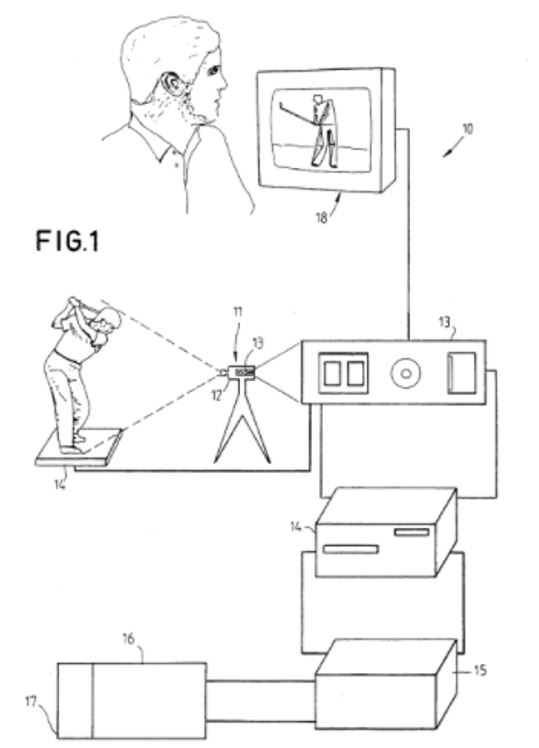
U.S. Patent No. 9,427,668: Storage medium storing game program and game apparatus for improved collision detection in a video game
Issued August 30, 2016, to Nintendo Co., Ltd.
Priority Date May 29, 2009


Summary:
U.S. Patent No. 9,427,668 helps fans of fighting and shoot ‘em up games make sure lag does not stop them from winning a game. In these sort of games, “determination areas” help figure out if objects in a game contact each other, which helps determines if a bullet shot from an enemy hits a player. Conventional televisions usually temporarily store a program received from a broadcast station in its memory and process the image to improve the image quality before displaying it. For game consoles, the temporary storage causes a lag between the execution of a player’s action and the display of the result on the television.

Therefore, this patent provides a solution using a storage medium for a game program and a game apparatus. In the game apparatus, the aforementioned “determination areas” repeatedly determine whether or not a player contacts something. The results of these determinations are stored in succession, permitting the player to move when there is an indication the player contacts something. Storing the determinations reduces lag and helps players keep fighting and dodging both enemies and bullets.

Abstract:
A computer readable storage medium storing a game program and a game apparatus capable of preventing a game process which is performed, depending on a result of contact determination with respect to objects from being illogical for a player are provided. In the game apparatus, a contact determination section repeatedly determines whether a player object contacts a block. The results of determination are successively stored into a determination result storing section. A first processing section permits the player object to jump when, of the results of determination stored in the determination result storing section, at least one result of determination including a result of determination a predetermined period of time before indicates that the player object contacts the block.

Illustrative Claim:
1. A non-transitory computer readable storage medium storing a game program executable by a computer of a game apparatus which outputs to a display device a game image showing a behavior of an object in a game space, the game program causing the computer to execute instructions comprising: repeatedly determining whether or not a first object contacts a second object at a first point in time and at a second point in time, the second point in time being a latest result of determination stored after the first point in time; successively storing results of the repeated determination; and performing a predetermined process with respect to the first object when, of the results of the stored determination, at least one result of determination includes determining that the first object contacted the second object at the first point in time.


Research By: Rachel Johns
Edited By: Andrew F. Thomas


U.S. Patent No. 9,566,503 Massively single-playing online game
Issued February 14, 2017, to Nintendo Co. Ltd.


Summary:
A huge draw to online games, especially MMORPGs, is the impact one person can have on another person’s game. Games like World of Warcraft, Second Life, or Minecraft are built around the concept of people interacting in an online digital world. Minecraft allows players to interact with features built by other players. To affect the world in these multi-player games, all the players inhabit the same world. Interacting with all the players can both be a positive and a negative experience.

What if a player wants to play a single-player game but still have other people affect the game world? U.S. Patent No. 9,566,503 (the ‘503 Patent) describes a method for a massively single-player online game. According to the patent, the game will be a traditional single-player game, but every player occupies the same digital world. Players will not be able to see or interact directly with other players, but the actions of a player can affect others by changing the game world. For example, a player could build a house in this digital world. A second player would be able to see and interact with the house, but could not see or communicate with the person who built the house.

The ‘503 Patent sounds similar to the kind of multiplayer experience found in the Dark Souls games. Dark Souls is primarily a single-player game but has a few multiplayer features. Players in Dark Souls can invade another player’s game, leave “helpful” notes in the world, or summon a friend to defeat a demanding boss. Demon Souls, the predecessor to Dark Souls, would alter gameplay depending upon world and individual character tendencies. The ‘503 Patent describes a game where foreign players affect the game world more directly than what happened in Demon Souls, but also more isolated than that of Dark Souls.

Abstract:
A method and apparatus that allows a player to play a massively single-player online game without directly interacting with other players, while affecting and being affected by other players playing the online game.


Illustrative Claim:
1. A method for playing a massively multiplayer online game that provides a massively multiplayer-affected shared game experience without requiring interaction between human-controlled player characters, comprising: simulating a virtual game environment using an online server processor; establishing connections between human players and the online server processor to establish respective game sessions which include player characters that interact with the simulated virtual game environment under direct control received from said human players over said established connections; storing, with the server processor, updated parameters related to the game sessions being played by the human players, said updated parameters related to changes to the simulated virtual game environment caused by massively multiplayer-controlled player characters interacting with the simulated virtual game environment; in response to the updated parameters, using the processor to simulate changing game conditions within the simulated virtual game environment, the changing game conditions dynamically changing over time based on interactions of massively multiplayer-controlled player characters with the simulated virtual game environment to thereby reflect said massively multiplayer-controlled player character interactions with the simulated virtual game environment; establishing a connection between an additional human player and the server processor to establish a further game session which includes a further player character directly controlled by said additional human player; and using the server processor, displaying, in the further game session played by the additional human player, game images according to the simulated virtual game environment and changing game conditions simulated in accordance with the updated parameters thereby exposing the additional human player's controlled player character to the effect of changing game conditions reflecting said massively multiplayer-controlled player character interactions within the simulated virtual game environment, said additional human player's controlled player character being at the same position in the simulated virtual game environment and at the same time with the simultaneously-online human players'-controlled player characters, without allowing said additional human player's controlled player character to see or interact with the other simultaneously-online human players'-controlled player characters.


Researched By: Andrew F. Thomas
On April 9, 2018, the Federal Circuit ruled in favor of defendants Microsoft Corporation, Ubisoft, Inc., Nintendo of America, Inc., Electronic Arts Inc., Harmonix Music Systems, Inc., and Majesco Entertainment in a patent infringement suit brought by Australian individual Richard J. Baker.   The suit relates to Baker’s U.S. Patent No. 5,486,001, which relates to an instructional aid for movements.  The accused products included video games that incorporated an image capturing device (like a camera) connected to a gaming console or personal computer.


The ’001 Patent reads, in claim 1 and as amended during prosecution:
capturing and storing initial visual image signals representative of a particular movement at a first location,

storing preferred image signals representative of a selected preferred movement at a second location remote from said first location in a data base of a computer,

transmitting said captured and stored visual image signals from said first location to said computer at said second location,

. . .

transmitting said regenerated signals from said computer at said remote second location to said first location and stored in image presentation means which permits viewing thereof with dialogue relating to said regenerated visual secondary image signals.

The Federal Circuit affirmed the district court’s finding that “remote,” as used above, requires “more than physical separation at the same location.”  The Federal Circuit found that this amendment prevented infringement by any of the defendants, both literally and under the doctrine of equivalents.

Cases like these emphasize the importance of careful patent prosecution.  Per the Federal Circuit, the “first location” and “second limitation” language used above was added to traverse a reference (U.S. Patent No. 5,184,295 to Mann).  Little changes like these, which invoke the doctrine of prosecution history estoppel, can have significant ramifications during litigation, as demonstrated here.  It’s game over for Mr. Baker in this case.

On March 27, 2018, Hybrid Audio, LLC (“Hybrid Audio”) sued Nintendo of America Inc. and Nintendo Co., Ltd. (“Nintendo”) for alleged infringement of RE 40,281, a reissue of U.S. 6,252,909.  The allegedly infringing products include the Nintendo Wii and the Nintendo DS.  RE 40,281 generally relates to signal processing and is part of technology used for MP3 technology, and Hybrid Audio’s argument is that Nintendo infringes via practicing various parts of the MP3 technical standard (ISO/IEC 11172-3:1993).


As part of Hybrid Audio’s complaint, it notes that Nintendo may enter a Reasonable and Non-Discriminatory (“RAND”) agreement to license RE 40,281 as part of the MP3 Standards. Hybrid Audio also indicates that products supplied by Microsoft Corporation are not part of the allegedly infringing products, suggesting that Microsoft has possibly already entered into such an agreement.

RAND agreements, sometimes called FRAND agreements (for “Fair, Reasonable, and Non-Discriminatory”), are commonly used in patent pools. In industries where standards (e.g., audio standards like MP3 and cellular communications standards like 3G or LTE) are important, patent owners often collectively pool “standards-essential” patents and mutually agree to license those patents on FRAND/RAND terms. For patent owners, this can be a good deal: once their patents become standards-essential, users of the standard must license their patent, albeit on RAND/FRAND terms. For licensees, this can also be a good deal: because all patent owners must license their standards-essential patents on RAND/FRAND terms, they can usually acquire licenses to the standard fairly easily and with reasonable terms.

Strangely, Hybrid Audio's complaint specifically identifies the Nintendo Wii and Nintendo DS as infringing products.  The Nintendo Wii was launched in 2006, whereas the Nintendo DS was launched in 2004.  35 U.S.C. § 286 limits damages to six years prior to the filing of a complaint, meaning that Hybrid Audio's recovery will be limited to the period from 2012 to 2018.  During that period, Nintendo was marketing different a next generation of game consoles (the Wii U and the 3DS), which are not referenced in Hybrid Audio's complaint.  Potential damages related to sales of the Wii and DS are likely to be extremely small.
On Feb. 7, 2018, Nintendo Co., Ltd. and Nintendo of America, Inc. (“Nintendo”) filed two petitions for Inter Partes Review of U.S. 6,219,730 to Nguyen, a patent owned by Genuine Enabling Technology LLC (“Genuine”). 

The challenged ’730 Patent relates to user input:

1. A user input apparatus operatively coupled to a computer via a communication means additionally receiving at least one input signal, comprising:
   user input means for producing a user input stream;
   input means for producing the at least one input signal;
   converting means for receiving the at least one input signal and producing therefrom an input stream; and
   encoding means for synchronizing the user input stream with the input stream and
   encoding the same into a combined data stream transferable by the communication means.
According to Nintendo, the ’730 Patent is anticipated at least in part by the practice of “bit-robbing” which, in short, involves combining an existing signal (e.g., an audio signal) with other signals (e.g., input signals) such that a single data stream could be used to transmit multiple types of data from multiple input.  For instance, Fig. 1B of the ’730 Patent depicts plugging a microphone and speaker into the mouse, in effect combining audio and input data streams:


The use of means-plus-function language may make these claims narrower in scope than they look at first glance.  Before granting Nintendo’s IPR petition, the USPTO Patent Trials and Appeals Board (“PTAB”) will have to figure out what structure is required by the claimed means, and whether Nintendo’s prior art shows that structure.

Nintendo’s Petition for Inter Partes review comes on the heel of the case Genuine Enabling Technology LLC v. Nintendo Co., 1:17-CV-00134-MSG, filed in the District of Delaware on Feb. 8, 2017.  In that case, Genuine asserts that Nintendo’s Wii Remote infringes the ’730 Patent. Per Nintendo, Genuine has also sued Sony for infringement of the same patent.
On January 12, 2018, photographer Christopher Sadowski sued IGN Entertainment, Inc. (“IGN”) for copyright infringement.  The copyright in question: a photograph of the Pokémon GO homepage on Sadowski’s cell phone, similar to (but not the same as!) the stock photo shown below.


Sadowski licensed his photograph to the New York Post for a July 12, 2016, article regarding a man who got caught cheating on his girlfriend through Pokémon GO.  It appears that IGN may have infringed Sadowski’s copyright by using the image when discussing the New York Post article in an IGN Hungary article titled “6 Crazy Pokémon GO Stories.”  The image is absent from IGN’s U.S. version of the article.

However, Sadowski’s case may have an Achilles' heel.  Because Niantic and Nintendo have intellectual property rights in their game (including the login screen), Sadowski’s photograph is arguably a derivative work, and his copyright would thereby extend only to the “material contributed by the author of such work, as distinguished from the preexisting material employed in the work.”  That’s not likely to be much.  Moreover, whatever minimal copyright Sadowski has in his photo “does not imply any exclusive right in the preexisting material.”  Lastly, protection for a derivative work using someone else’s material in which copyright subsists does not extend to any part of the work in which such material has been used unlawfully (e.g., without the appropriate license).  In other words, there’s a fair argument that Sadowski’s photograph rights are only as good as Nintendo and/or Niantic will allow them to be.

Sadowski’s case against IGN is a cautionary tale for Internet content creators. While many questions about the applicability of fair use on the Internet exist, it remains a bad idea to use images from other websites–even news websites–without appropriate permission.  Indeed, a royalty free version of the exact same photo exists and could have saved IGN a lot of grief.
U.S. Patent No. 8,690,653: Video game systems and methods
Issued Apr. 8, 2014, to Nintendo Co., Ltd.


Summary:

The ‘653 patent covers multiplayer games in which each player controls a separate character and, under certain conditions, a character may become invincible. Each player uses a separate controller. While a character is invincible, the character responds to a different control scheme than when a character is susceptible to damage.


Abstract:

Example systems and methods relate to a video game in which multiple players each supply inputs to a respective input device to control a corresponding game character in a game world. Movements and actions of each game character are controlled in accordance with respective first game character control operations during the playing of the video game. If one of a plurality of conditions is satisfied by one of the players, the one player's game character is protected from harm in the game world. Movements and actions of the protected game character are controlled in accordance with a second game character control operation. The protecting of the one player's game character is stopped in response to one or more protecting stopping conditions, whereby the game character is again controllable in accordance with the first game character control operation.


Illustrative Claim:

1. A method comprising:
while playing a multi-player video game in which multiple players each supply inputs to a respective input device to control a corresponding game character in a game world displayed on a display screen,
controlling movements of each game character in the game world in accordance with respective first game character control operations during the playing of the multi-player video game;
in response to satisfaction of any one of a plurality of conditions by one of the players, protecting the one player's game character from harm in the game world, wherein the plurality of conditions include both voluntary conditions based on the one player's inputs and involuntary conditions automatically imposed by the multi-player video game;
controlling movements of the protected game character in the game world; and
stopping the protecting of the one player's game character in response to one or more protecting stopping conditions, whereby the movements of the one player's game character in the game world are controllable in accordance with the first game character control operation for that game character.

U.S. Patent No. 8,491,365: Sports video game with enhanced control features
Issued Jul. 23, 2013, to Nintendo Co., Ltd.


Summary:

The ‘365 patent applies to sports video games with battle game aspects. The described game may deal damage instead of awarding points, allowing rounds of play to last longer. An in game character who has taken too much damage or lost too much health may be removed from play or die in the game. The player may use power-ups or different moves to increase the damage dealt by a particular play. The patent focuses on the integration of competitive battle game qualities into traditional sports games.


Abstract:

A battle volleyball or other sports game having both sports and battle game aspects is played between opposing teams. A game object, having at least one associated characteristic, is used in the game. An associated characteristic of the game object is altered based on properly timed player input, the input being timed to coincide with one or more action indicators displayed along a game object movement path. The game object may also negatively affect a health or other game character related parameter of a game character towards which the game object is directed.


Illustrative Claim:

1. A method of playing a battle video game providing a video game play graphical user interface in accordance with instructions executed by at least one processor, the processor providing images for display and changing the images in response to user input, the method comprising:
using the at least one processor, modeling at least one ball;
using the at least one processor, and initiated based on input from a first user, generating
animation for display that shows the ball flying along a trajectory;
using the at least one processor, displaying at least one action indicator along the trajectory of said ball the action indicator having features;
using the at least one processor, accepting further input from the first user and determining timing of the further input relative to when the ball has correspondence with features of the action indicator; and
using the at least one processor, based on the further input from the first user, applying a power boost to the ball while it is flying along the trajectory.

Cherdak v. Nintendo of North America, Inc.
United States District Court, Eastern District of Virginia
Case No. 2:15-cv-366
Filed August 14, 2015

Plaintiff Erik B. Cherdak is a pro se applicant who sued Nintendo of America on August 14, 2015. Plaintiff sued Defendant for the alleged past infringement of his Patent Nos. 5,343,445 and 5,452,269. The patents-in-suit, entitled “Athletic Shoe with Timing Device,” cover a device for measuring the amount of time an athletic shoe is in the air, similarly known as a pedometer.

Below is an exemplary claim from the ’445 patent:

1. A method for indicating hang time off the ground and in the air during a jump by a person wearing an athletic shoe, said method comprising the steps:
(a) sensing, within said shoe, when said shoe leaves the ground during said jump;
(b) sensing, within said shoe, when said shoe returns to the ground at the end of said jump; and
(c) activating a hang time indicator on said shoe during the time interval between said shoe leaving and returning to the ground as sensed in steps (a) and (b), respectively, said indicator providing an indication of hang time in a manner perceptible to said person.

The ‘445 patent issued August 30, 1994, and the ‘269 patent issued September 19, 1995.  The filing dates for these patents were prior to June 8, 1995, when the 1994 Uruguay round of the GATT changed the rules for calculating patent term. Under the old rules, the patents-in-suit expired 17 years from the date of issue or 20 years from the earliest non-provisional priority date, whichever date is greater. Therefore, absent mitigating circumstances these patents expired July 6, 2013.

The accused products are the Nintendo DS “Personal Trainer: Walking” line, which includes a pedometer for tracking steps and other activities. The device can be worn on shoes or other articles of clothing.  The accused product also contains software for operating and controlling the device to allow users to set personal health goals.

In the complaint Plaintiff is asking for royalties for the alleged past infringement by Nintendo.


It is worth mentioning that Erik Cherdak has filed approximately 40 lawsuits for patent infringement of these two patents over the last ten years.


We will watch for any interesting developments in this case.
    Home     Next >

Get the Patent Arcade App

Get the Patent Arcade App
Available now for iOS

Search This Blog


Recognition

Buy your copy today!

Buy your copy today!
ABA Legal Guide, 2d Ed.

Ross Dannenberg

Scott Kelly

Scott Kelly

Labels

Archives

Blogroll

Data Analytics

Copyright ©2005–present Ross Dannenberg. All rights reserved.
Visit BannerWitcoff.com