Visit BannerWitcoff.com
Showing posts with label Electronic Arts. Show all posts
U.S. Patent No. 9,616,329: Adaptive learning system for video game enhancement
Issued April 11, 2017, to Electronic Arts, Inc. 
Priority Date June 28, 2012


Summary:
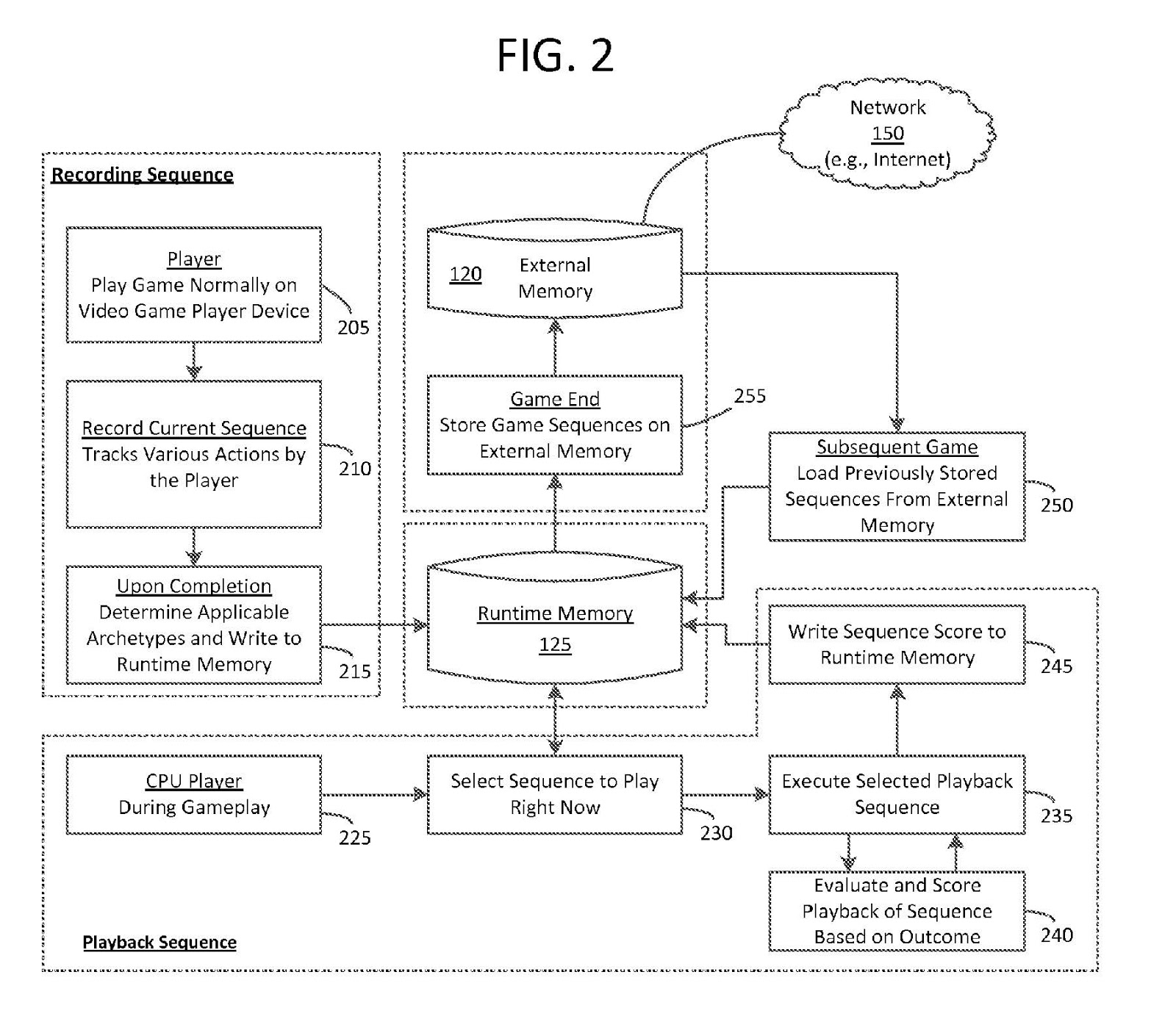
U.S. Patent No. 9,616,329 (the '329 Patent) describes a system for adaptive learning in a video game engine. AI opponents often fail to replicate the adaptive learning abilities of a human opponent. A human can quickly analyze an opponent's strategy and adjust easily. The '329 Patent hopes to change that by providing a system to implement adaptive learning into a video game. According to the patent, the game will begin to record the gameplay of an initial match. Upon completion of the match, the system will analyze the recording for key moments and player habits which lead to the outcome. For example, in Madden, the game will analyze the sequence and moments that allowed the human player to score a touchdown. The resulting analysis and recorded sequence are stored within the system's memory. During the second match, the system uses the recording to identify human player's habits. Using the analysis from earlier, the computer opponent adjusts its tactics to counter the human player. The player may find that the running play that once scored touchdowns is no longer a viable option.


Abstract:
Techniques are disclosed that can capture sequences of player input in response to situations confronting a player of a video game while playing the video game on a game console. A game engine within the game console may associate an archetype with the captured sequences. The outcomes of the captured sequences are determined with respect to the game situations and a score is applied to the captured sequences based on the outcomes. The captured sequences, the outcomes and the scores are stored in a runtime memory within the game console used to play the video game. Upon completion of the video game, the stored captured sequences, the outcomes and the scores may be downloaded and stored to an external memory associated with the game console. Subsequent video game sessions may load the captured sequences, the outcomes and the scores into the runtime memory to be used in the next session.

Illustrative Claim:
1. A method comprising: during runtime execution of a video game application on a computing device, the video game application comprising a virtual environment, capturing sequences of player input in response to one or more virtual events confronting a player controlled virtual agent within the virtual environment of the video game application; for individual captured sequences, determining an outcome of the captured sequence with respect to a virtual event of the one or more virtual events; applying a score to the captured sequence based, at least in part, on the outcome; storing the captured sequence, the outcome, and the score in a runtime memory within the computing device used to play the video game application; in response to a virtual event confronting a computer controlled virtual agent within the virtual environment, identifying one or more captured sequences based, at least in part, on a game status and computer controlled virtual agent status associated with the virtual event confronting the computer controlled virtual agent; selecting a captured sequence from the one or more captured sequences based, at least in part, on the scores and outcomes associated with the individual sequences; and executing the selected captured sequence by the computer controlled virtual agent in response to the virtual event confronting the computer controlled virtual agent within the virtual environment.


Researched By: Andrew F. Thomas


Infernal Technology, LLC et al v. Crytek GmbH
United States District Court for the Eastern District of Texas
Docket No. 2-18-cv-00284, filed July 10, 2018

On July 10, 2018, Infernal Technology and Terminal Reality (Infernal) filed a lawsuit in the Eastern District of Texas alleging that Crytek GmbH (Crytek) infringed upon U.S. Patent Nos. 6,362,822 (the '822 Patent) and 7,061,488 (the '488 Patent). The two patents relate to lighting and shadowing methods in computer graphic simulations.

Image from the '822 Patent, Fig. 2.

Claim 1 of the '822 Patent reads:
A shadow rendering method for use in a computer system, the method comprising the steps of:

providing observer data of a simulated multi-dimensional scene;

providing lighting data associated with a plurality of simulated light sources arranged to illuminate said scene, said lighting data including light image data;

for each of said plurality of light sources, comparing at least a portion of said observer data with at least a portion of said light data to determine if a modeled point within storing at least a portion of said light image data associated with said point and said light source in a light accumulation buffer; and then

combining at least a portion of said light accumulation buffer with said observer data; and

displaying resulting image data to a computer screen. ('822 patent, col 12, lines 4-21).

Infernal claims that Crytek's utilization of video game engine "CryEngine" allegedly infringes the asserted patents. According to the Complaint, Crytek used the allegedly infringing game engine to develop the Crysis series, Warface, Ryse: Son of Rome, The Climb, and Robinson: The Journey.

Typically, the next step for a defendant in this situation is to petition the Patent Trial and Appeal Board (PTAB) for an Inter Partes Review (IPR), but the '822 and '488 Patents have already survived an IPR because of earlier litigation. In 2015, Infernal sued Electronic Arts for patent infringement. EA responded by petitioning the PTAB for an IPR; however, the PTAB found the '822 and '488 Patents to be "Not Unpatentable." EA settled the lawsuit after the PTAB's decision. Crytek can still petition for an IPR of the asserted patents, but will likely have to use different prior art that the art used by EA or provide a good reason why the Board got it wrong the first time around.

If this seems like deja vu that is because Infernal filed complaints similar to the Crytek Complaint against Microsoft in April and against Activision Blizzard in May. To read our blog post on the Microsoft case click here.  We will continue to monitor all three of these cases and provide updates when possible.
On April 11, 2018, Infernal Technology, LLC and Terminal Reality, Inc. (“Infernal”) filed a complaint for patent infringement against Microsoft Corporation (“Microsoft”).  The asserted patents, U.S. 6,362,822 and U.S. 7,061,488, relate to lighting and shadowing methods for graphics simulation. According to Infernal, both patents have already survived an Inter Partes Review challenge filed by Electronic Arts in 2016.


According to the complaint, Terminal Reality was the developer of games such as Nocturne, Bloodrayne, Ghostbusters: The Video Game, Kinect Star Wars, The Walking Dead: Survival Instinct.  As part of their game development work, Terminal Reality developed a graphics engine (“Infernal Engine”).  Infernal Technology has an exclusive license to patents related to the Infernal Engine, including those asserted against Microsoft.

Infernal alleges that games developed by Microsoft on the Unreal Engine 4, CryEngine 3, CryEngine 4, Alan Wake Engine, Renderware Engine, Forge Engine Forzatech Engine, Northlight Engine, Unity Engine, Foundation Engine, Halo 4 Engine, Halo 5: Guardians Engine, and Halo: Reach Engine infringe the asserted patents.  These allegations seem to include the lions’ share of games on Microsoft’s consoles, including but not limited to Alan Wake, Crackdown, Crackdown 2, Crackdown 3, Dead Rising 3, Fable Legends, Forza Motorsport 6, Forza Motorsport 7, Gears of War 4, Halo 4, Halo 5: Guardians, Halo: Reach, Kalimba, Ori and the Blind Forest, PlayerUnknown’s Battlegrounds, Quantum Break, ReCore, Rise of the Tomb Raider, Ryse: Son of Rome, Sea of Thieves, State of Decay, and Super Lucky’s Tale.

Interestingly, Infernal’s case was filed in the Eastern District of Texas.  While that venue was once a hotbed of patent litigation, in TC Heartland LLC v. Kraft Foods Grp. Brands LLC, 137 S. Ct. 1514 (2017), the Supreme Court limited venue in patent infringement actions to where (1) the defendant resides, or (2) the defendant has committed acts of infringement and has a regular and established place of business.  This ruling has generally been seen as a significant limitation on bringing cases in the Eastern District of Texas.  Nonetheless, Infernal alleges that Microsoft is a resident of the State of Texas, has a designated agent for service of process in the State of Texas, and has committed acts of infringement in the State of Texas.  Whether the facts underlying these assertions are sufficient for venue in the Eastern District of Texas after TC Heartland remains to be seen.

We will monitor this case and keep our readers informed of any updates.
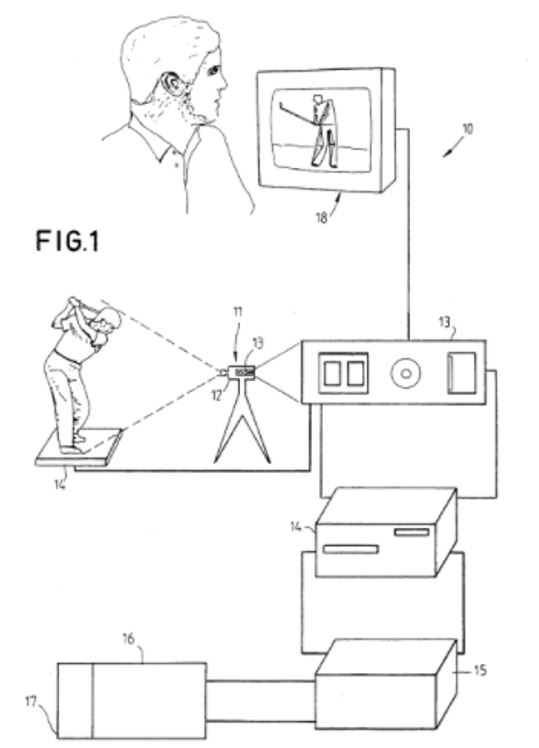
On April 9, 2018, the Federal Circuit ruled in favor of defendants Microsoft Corporation, Ubisoft, Inc., Nintendo of America, Inc., Electronic Arts Inc., Harmonix Music Systems, Inc., and Majesco Entertainment in a patent infringement suit brought by Australian individual Richard J. Baker.   The suit relates to Baker’s U.S. Patent No. 5,486,001, which relates to an instructional aid for movements.  The accused products included video games that incorporated an image capturing device (like a camera) connected to a gaming console or personal computer.


The ’001 Patent reads, in claim 1 and as amended during prosecution:
capturing and storing initial visual image signals representative of a particular movement at a first location,

storing preferred image signals representative of a selected preferred movement at a second location remote from said first location in a data base of a computer,

transmitting said captured and stored visual image signals from said first location to said computer at said second location,

. . .

transmitting said regenerated signals from said computer at said remote second location to said first location and stored in image presentation means which permits viewing thereof with dialogue relating to said regenerated visual secondary image signals.

The Federal Circuit affirmed the district court’s finding that “remote,” as used above, requires “more than physical separation at the same location.”  The Federal Circuit found that this amendment prevented infringement by any of the defendants, both literally and under the doctrine of equivalents.

Cases like these emphasize the importance of careful patent prosecution.  Per the Federal Circuit, the “first location” and “second limitation” language used above was added to traverse a reference (U.S. Patent No. 5,184,295 to Mann).  Little changes like these, which invoke the doctrine of prosecution history estoppel, can have significant ramifications during litigation, as demonstrated here.  It’s game over for Mr. Baker in this case.
On Feb. 8, 2018, Pure Data Systems, LLC (“Pure”) sued Electronic Arts, Inc. (“EA”) and Ubisoft, Inc. (“Ubisoft”) for alleged infringement of U.S. Patent Nos. 5,999,947 to Zollinger et al. and 6,321,236 to Zollinger et al.  


Claim 1 of the ’947 Patent reads:
1. A method of distributing database differences corresponding to change events made to a database table located on a server computer to client copies of the database table located on one or more client computers comprising the steps of:
  creating and storing on the server computer one or more sequentially versioned updates, each update containing database differences in a generic format, the database differences corresponding to database change events made to the database table since the preceding update;
  receiving, from a client computer, a request for all the database differences needed to make the client copy of the database table current;
  determining which updates are necessary for making the client copy of the database table current;
  ascertaining a client database engine type wherein the client copy of the database table is held;
  generating and translating specific database differences, selected based on the necessary updates, into instructions based on the ascertained database engine type prior to transmission; and
  transmitting the specific database differences to the client computer so that the client computer may execute the instructions on the client database engine, thereby making the client copy of the database table current in response to the specific database differences translated into the instructions.
Pure claims that EA and Ubisoft infringe their patents via their “game library updates.”  For example, “if a user purchases a game through the [EA’s] Origin website using a browser, the user’s game library is updated on a server” such that “[w]hen the user next logs into the Origin client, those updates are transmitted to the Origin client running on the user’s computer.”

The lawsuits against EA and Ubisoft are different, likely due to venue issues, but the complaints are almost identical. Pure appears to have also filed similar complaints against Valve Corporation, the Fox News Network, Imgur, CNET, CNN, and Pinterest, among others.  
    Home     Next >

Get the Patent Arcade App

Get the Patent Arcade App
Available now for iOS

Search This Blog


Recognition

Buy your copy today!

Buy your copy today!
ABA Legal Guide, 2d Ed.

Ross Dannenberg

Scott Kelly

Scott Kelly

Labels

Archives

Blogroll

Data Analytics

Copyright ©2005–present Ross Dannenberg. All rights reserved.
Visit BannerWitcoff.com