Visit BannerWitcoff.com
Showing posts with label Lawsuit. Show all posts
 

PUBG Corp., the Korean Subsidiary of Bluehole Studios (the developer of PlayerUnknown's Battlegrounds), has dropped its lawsuit against Fortnite developer Epic Games Inc. PUBG had filed a copyright infringement claim against Epic in South Korea back in January. According to reports, PUBG alleged that Epic had copied PlayerUnknown's assets and user interface. You can read our coverage here. However, on Monday, PUBG sent a letter of withdrawal to Epic's lawyers and the South Korean case was closed. Neither side has stated a reason for the withdrawal. PUBG's lawsuit against Netease Inc. is still ongoing, and we will continue to provide updates when available.

It is worth noting that Tencent Holdings Ltd., a Chinese social media/gaming company, is a part-owner in both Bluehole Studios and Epic - each to the tune of hundreds of millions of dollars - and might not want its investments suing each other. Also, PlayerUnknown's currently runs on Epic's Unreal Engine 4, which could also play a part in the settlement. We may never known the exact reason PUBG withdrew, but the cross-over between the two sides could have been a significant factor. As of right now, this appears to be the end of the legal conflict between PUBG and Epic.
Groove Digital, Inc. v. King.com, LTD. et al.,
United States District Court for the District of Delaware,
1-18-cv-00836, filed 06/04/2018
 
 
On June 4, 2018, Groove Digital filed a lawsuit in the District Court of Delaware alleging King.com infringed upon U.S. Pat. No. 9,454,762 (the '762 Patent), titled "System and Method for Delivery of Content to a Network Device." Groove Digital claims the '762 Patent relates to push notifications for mobile apps. In the Complaint, King's game, Candy Crush Saga, infringes upon the '762 Patent.

Claim 1 of the '762 Patent reads:
A system for delivering information to a networked device of a user, the system comprising:

a microprocessor running a software application for delivering an applet application to the networked device and managing the delivery of the applet application to the networked device, wherein the applet application passively deploys one or more applets at a time of deployment,

wherein the applet application provides for delivery of content to the networked device and a display of the content in a predetermined portion of a user display that is less than an entire display of the networked device, by the one or more applet, wherein the one or more applet is configured to deploy at least one of independent of or in conjunction with an internet browser window, wherein an internet browser is configured to deploy subsequent to deployment of the one or more applets based on at least one action or inaction of the user, wherein at least one of the applets is configured to become idle upon deployment of the internet browser, and wherein the deployment of the one or more applets is such that at the time of deployment of the one or more applets the user can continue to operate the networked device in a state prior to the deployment of the one or more applets;

a first database coupled to the microprocessor and storing a first set of information relating to the user; and

a second database coupled to the microprocessor and including a second set of information for comparison to the first set of information,

wherein the microprocessor compares the first set of information to the second set of information to determine whether the content should be transmitted to the networked device for display by the one or more applets. ('762 patent, col. 14, lines 9-43).

The '762 Patent has an interesting prosecution history. Samuel Gaidemak and Paul Chacko filed the '762 Patent on March 17, 2006, but the USPTO did not issue the patent until September 27, 2016. During those ten years, the PTO issued eleven office actions against the '762 Patent. On average a patent will face three or four office actions. The more office actions a patent faces, the more prosecution history estoppel the patent acquires, which is used to narrow the patent's claims and restrict the owner's use of the doctrine of equivalents. Groove Digital is asserting the doctrine of equivalents in addition to allegations of literal infringement. King has not yet filed an Answer in response to the Complaint.

Groove Digital is also suing United Bank for infringing the '762 Patent. Normally, we do not report on non-video game related case, but this is the only other lawsuit in which the '762 Patent is asserted. Groove Digital filed the lawsuit against United Bank on December 1, 2017, in the Eastern District of Virginia. The Complaint in that lawsuit alleges that United Bank's mobile banking app infringes the '762 Patent by using push notifications, and the Complaint filed against United Bank is very similar to the Complaint filed against King. United Bank has only filed a motion to dismiss for lack of jurisdiction. These lawsuits against United Bank and King could be the start of Groove Digital suing every mobile app developer that uses push notifications, so it will be interesting to see if Apple takes notice (in view of the integrated push notification technology built into iOS).

We will continue to follow Groove Digital's lawsuit against King and provide updates when available.
On April 23, 2018, Epic Games, Inc. (“Epic”) filed a response to a Motion to Dismiss filed by Lauren Rogers, the mother of a teenaged Fortnite hacker (“C. R.”) facing a copyright infringement and breach of contract lawsuit filed by Epic last year.


Epic’s complaint argues that C.R. infringed its copyrights by injecting unauthorized computer code (that is, cheats) into Fortnite.  C.R. allegedly recorded himself cheating in Fortnite and uploaded those videos to YouTube.  Epic filed a DMCA request to take down those videos, to which CR apparently replied: “i did noting rong this strike is all wrong I was modding in a video game that isn’t against youtubes TOS Why was i striked ‼!.”  According to Epic, C.R. had been banned from Fortnite at least fourteen times, but continued to dodge bans using fake names.  Neither C.R. nor his mother have legal counsel.

The suit is extremely similar to Epic’s other Fortnite lawsuits (discussed here, here, here, herehere, here, and here). 

Ms. Roger’s Motion to Dismiss, actually a letter filed by Ms. Rogers, allegedly admits that C.R. was a cheater but argues that the case should be dismissed because (1) Epic “has no capability of proving [that C.R. performed] any form of modification,” because (2) Epic “illegally” released C.R.’s name, because (3) Epic cannot prove “profit loss” from the cheating or that C.R. profited from his cheating, and (4) because Epic’s contracts (e.g., its terms of service) are invalid because C.R. is a minor.  Epic responded by not only moving to seal certain portions of the trial record, but also by arguing that it was not required to make certain proofs at the pleading stage, and that, in any event, Ms. Roger’s arguments were legally unfounded.

These developments appear to put Epic in a useful, albeit awkward, position.  On one hand, this suit provides a clear warning that even minors may find themselves sued for cheating in Fortnite.  On the other hand, Epic is now pursuing a copyright suit against an unrepresented teen and his mother – definitely an interesting position from a public relations perspective.

On April 11, 2018, Infernal Technology, LLC and Terminal Reality, Inc. (“Infernal”) filed a complaint for patent infringement against Microsoft Corporation (“Microsoft”).  The asserted patents, U.S. 6,362,822 and U.S. 7,061,488, relate to lighting and shadowing methods for graphics simulation. According to Infernal, both patents have already survived an Inter Partes Review challenge filed by Electronic Arts in 2016.


According to the complaint, Terminal Reality was the developer of games such as Nocturne, Bloodrayne, Ghostbusters: The Video Game, Kinect Star Wars, The Walking Dead: Survival Instinct.  As part of their game development work, Terminal Reality developed a graphics engine (“Infernal Engine”).  Infernal Technology has an exclusive license to patents related to the Infernal Engine, including those asserted against Microsoft.

Infernal alleges that games developed by Microsoft on the Unreal Engine 4, CryEngine 3, CryEngine 4, Alan Wake Engine, Renderware Engine, Forge Engine Forzatech Engine, Northlight Engine, Unity Engine, Foundation Engine, Halo 4 Engine, Halo 5: Guardians Engine, and Halo: Reach Engine infringe the asserted patents.  These allegations seem to include the lions’ share of games on Microsoft’s consoles, including but not limited to Alan Wake, Crackdown, Crackdown 2, Crackdown 3, Dead Rising 3, Fable Legends, Forza Motorsport 6, Forza Motorsport 7, Gears of War 4, Halo 4, Halo 5: Guardians, Halo: Reach, Kalimba, Ori and the Blind Forest, PlayerUnknown’s Battlegrounds, Quantum Break, ReCore, Rise of the Tomb Raider, Ryse: Son of Rome, Sea of Thieves, State of Decay, and Super Lucky’s Tale.

Interestingly, Infernal’s case was filed in the Eastern District of Texas.  While that venue was once a hotbed of patent litigation, in TC Heartland LLC v. Kraft Foods Grp. Brands LLC, 137 S. Ct. 1514 (2017), the Supreme Court limited venue in patent infringement actions to where (1) the defendant resides, or (2) the defendant has committed acts of infringement and has a regular and established place of business.  This ruling has generally been seen as a significant limitation on bringing cases in the Eastern District of Texas.  Nonetheless, Infernal alleges that Microsoft is a resident of the State of Texas, has a designated agent for service of process in the State of Texas, and has committed acts of infringement in the State of Texas.  Whether the facts underlying these assertions are sufficient for venue in the Eastern District of Texas after TC Heartland remains to be seen.

We will monitor this case and keep our readers informed of any updates.
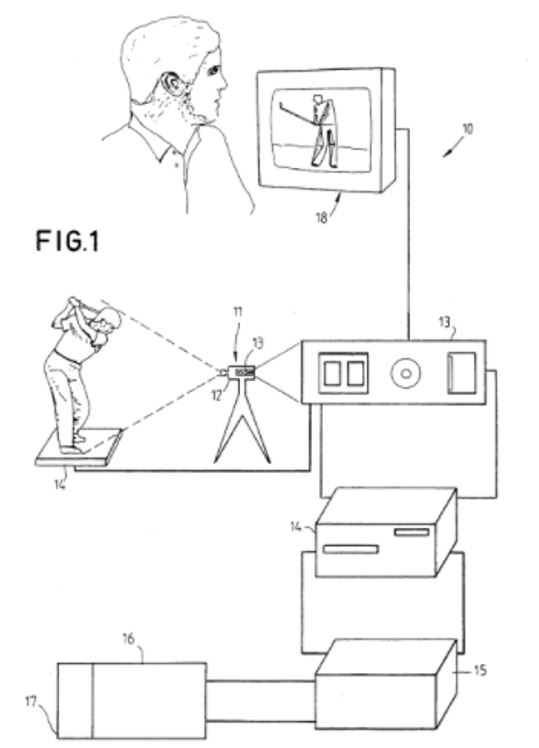
On April 9, 2018, the Federal Circuit ruled in favor of defendants Microsoft Corporation, Ubisoft, Inc., Nintendo of America, Inc., Electronic Arts Inc., Harmonix Music Systems, Inc., and Majesco Entertainment in a patent infringement suit brought by Australian individual Richard J. Baker.   The suit relates to Baker’s U.S. Patent No. 5,486,001, which relates to an instructional aid for movements.  The accused products included video games that incorporated an image capturing device (like a camera) connected to a gaming console or personal computer.


The ’001 Patent reads, in claim 1 and as amended during prosecution:
capturing and storing initial visual image signals representative of a particular movement at a first location,

storing preferred image signals representative of a selected preferred movement at a second location remote from said first location in a data base of a computer,

transmitting said captured and stored visual image signals from said first location to said computer at said second location,

. . .

transmitting said regenerated signals from said computer at said remote second location to said first location and stored in image presentation means which permits viewing thereof with dialogue relating to said regenerated visual secondary image signals.

The Federal Circuit affirmed the district court’s finding that “remote,” as used above, requires “more than physical separation at the same location.”  The Federal Circuit found that this amendment prevented infringement by any of the defendants, both literally and under the doctrine of equivalents.

Cases like these emphasize the importance of careful patent prosecution.  Per the Federal Circuit, the “first location” and “second limitation” language used above was added to traverse a reference (U.S. Patent No. 5,184,295 to Mann).  Little changes like these, which invoke the doctrine of prosecution history estoppel, can have significant ramifications during litigation, as demonstrated here.  It’s game over for Mr. Baker in this case.
On March 30, 2018, Universal Entertainment Corporation (“Universal”) sued Aruze Gaming America, Inc. (“AGA”) and Japanese billionaire Kazuo Okada (“Okada”).  The asserted patents generally relate to slot machines.  The accused products include a wide variety of products made by AGA, including the G-SERIES, G-STATION, CUBE-X family of games (e.g., “Fire and Thunder,” “King of Dragons,” and “Mighty Lion”).


This case is interesting not necessarily because of the patents themselves, but rather because of the alleged corporate drama involving Okada, Universal, and AGA.  According to the complaint, Okada was the founder of Universal, which at one point owned AGA as a subsidiary.  Around 2008, Universal allegedly transferred all of its shares of AGA to Okada, spinning off AGA as an independent company.  Around 2009, Okada allegedly instructed Universal employees to license certain patents to AGA, though a license was never executed.  Around June of 2017, Universal purportedly discovered that Okada committed some form of “misconduct in relation to foreign business,” purportedly costing Universal around 2.2 billion Japanese Yen (around 20 million US dollars).  According to the complaint and other news sources, Okada was later voted out of Universal (by, among others, his son, daughter, and wife), and Okada appears to have turned his attention to AGA while he attempts to regain control of Universal.

This case is an excellent example of a danger commonly faced by many companies: founder overreach.  Savvy, charismatic leaders can enable companies to grow fast, but such founders can become overly powerful and dominate company decision-making.  In the intellectual property context, this can easily result in inventorship disputes, questionable licensing practices, and attempted theft of intellectual property (e.g., trade secrets) by departing founders.  Needless to say, such issues can easily be remedied through careful legal counsel.

On March 27, 2018, Hybrid Audio, LLC (“Hybrid Audio”) sued Nintendo of America Inc. and Nintendo Co., Ltd. (“Nintendo”) for alleged infringement of RE 40,281, a reissue of U.S. 6,252,909.  The allegedly infringing products include the Nintendo Wii and the Nintendo DS.  RE 40,281 generally relates to signal processing and is part of technology used for MP3 technology, and Hybrid Audio’s argument is that Nintendo infringes via practicing various parts of the MP3 technical standard (ISO/IEC 11172-3:1993).


As part of Hybrid Audio’s complaint, it notes that Nintendo may enter a Reasonable and Non-Discriminatory (“RAND”) agreement to license RE 40,281 as part of the MP3 Standards. Hybrid Audio also indicates that products supplied by Microsoft Corporation are not part of the allegedly infringing products, suggesting that Microsoft has possibly already entered into such an agreement.

RAND agreements, sometimes called FRAND agreements (for “Fair, Reasonable, and Non-Discriminatory”), are commonly used in patent pools. In industries where standards (e.g., audio standards like MP3 and cellular communications standards like 3G or LTE) are important, patent owners often collectively pool “standards-essential” patents and mutually agree to license those patents on FRAND/RAND terms. For patent owners, this can be a good deal: once their patents become standards-essential, users of the standard must license their patent, albeit on RAND/FRAND terms. For licensees, this can also be a good deal: because all patent owners must license their standards-essential patents on RAND/FRAND terms, they can usually acquire licenses to the standard fairly easily and with reasonable terms.

Strangely, Hybrid Audio's complaint specifically identifies the Nintendo Wii and Nintendo DS as infringing products.  The Nintendo Wii was launched in 2006, whereas the Nintendo DS was launched in 2004.  35 U.S.C. § 286 limits damages to six years prior to the filing of a complaint, meaning that Hybrid Audio's recovery will be limited to the period from 2012 to 2018.  During that period, Nintendo was marketing different a next generation of game consoles (the Wii U and the 3DS), which are not referenced in Hybrid Audio's complaint.  Potential damages related to sales of the Wii and DS are likely to be extremely small.
Plaintiffs Lucasfilm Ltd. LLC and Lucasfilm Entertainment Company Ltd. LLC (“Lucasfilm”) have challenged attempts by defendant Ren Ventures Ltd. and Sabacc Creative Industries Ltd. (“Ren”) to dismiss a lawsuit by Lucasfilm alleging that Ren infringes Lucasfilm’s copyrights and trademarks and has violated unfair competition laws.  The game at issue is Ren’s “Sabacc,” a mobile card game which allegedly infringes Lucasfilm’s Star Wars trademarks.


“Sabacc” is the fictional game of chance in the Star Wars universe that was played by Han Solo to win the Millennium Falcon from Lando Calrissian.  Lucasfilm has sold various real-life versions of the Sabacc card game, though Ren disputes the significance of such sales.  According to Lucasfilm, on the eve of the release of the movie Star Wars: The Force Awakens (Dec. 18, 2015), Ren–without permission from Lucasfilm–released the mobile card game “Sabacc.”  Videos of the game available online suggest that it contains imagery which allegedly depict Han Solo, Lando Calrissian, and a holographic Millennium Falcon.  Lucasfilm sued Ren on December 21, 2017.

Ren’s Motion to Dismiss argues, in part, that because Sabacc is a “fictional good,” it cannot be amenable to trademark protection or an unfair competition violation.  Lucasfilm’s Opposition to Ren’s Motion to Dismiss calls Ren’s arguments “specious,” asserting that Ren “ignore[s] all cases that have granted common law trademark protection to fictional elements of expressive works.” 

As many franchises sell real versions of in-universe games (Star Trek’s Tri-Dimensional Chess and The Witcher’s Gwent come to mind), the ruling in this case may have implications far beyond Sabacc.
Konami, no stranger to invalidity challenges against their video gaming patents, recently had four more patents directed to slot machines struck down as directed to abstract ideas.

On Feb. 21, 2018, the U.S. District Court for the District of Nevada granted summary judgment for defendant High 5 Games, LLC (“High 5”) against plaintiff Konami Gaming, Inc. (“Konami”).  The Court, dismissing Konami’s case, found all four of Konami’s asserted patents invalid as directed to unpatentable subject matter.


In the case, Konami alleged infringement of four patents: U.S. Patent Nos. 8,096,869, 8,366,540, 8,662,810, and 8,616,955. All asserted patents generally relate to slot machines, and High 5’s allegedly infringing products included various online and “land-based” slot machine games featuring a “Super Stack” feature (including, inter alia, “Bah, Humbug,” “Bollywood Bride,” “Dangerous Beauty,” “Diamonds of Athens The Dream,” “Shadow of the Panther,” and many others).
Claim 1 of the ’869 Patent reads:
1. A gaming machine comprising:
   a processor configured to execute a game displaying a matrix of symbol containing elements having a plurality of rows and a plurality columns;
   at least one column of said matrix comprising a portion of a simulated rotatable reel of a plurality of said symbol containing elements;
   said simulated rotatable reel comprising sections of symbol containing elements displaying a plurality of symbols that are fixed for each game played on said gaming machine;
   said simulated rotatable reel including at least one section in which a consecutive run of three or more of said symbol containing elements is populated by an identical symbol so that, as the simulated rotatable reel rotates, a consecutive string of said same identical symbol is sequentially displayed within said consecutive string of symbol containing elements; and
   said identical symbol is randomly selected anew for each play of said game, wherein said identical symbol is selected by virtually spinning a notional, non-visible, inner reel comprising a subset of said plurality of symbols.
After a lengthy discussion of claim construction, the Court found Konami’s patents’ claims “individually and collectively” invalid for abstractness.  Per the Court, the claims “perform the functions of what may be described as an aesthetic variation on a play of the game” because “the primary focus of the patents, as acknowledged even by Konami, is displaying a consecutive run of a randomly selected identical symbol in one reel of the simulated digital reels in each iteration of a game as a means of increasing interest in the game and ‘increasing probability of a winning outcome.’”  The Court was unpersuaded that the claims recited more than this idea: “[c]hanging how often a symbol appears and where it appears in a slot game without more is simply altering the manner of display of random symbols – i.e. changing the rules of the game.”

This decision underscores the continued impact of the Supreme Court’s 2014 decision in Alice v. CLS Bank.  In this case, the Court was clear: “changes to game rules of a generic slot machine using conventional technology are not patentable.”  Such a ruling may suggest that patents directed to game play rules may also be invalid as directed to abstract ideas.  Patentees may improve their likelihood of surviving similar challenges by, where possible, tying their claimed inventions to technology and technical problems.
On January 30, 2018, Barbaro Technologies, LLC (“Barbaro”) sued Niantic, Inc. (“Niantic”) for the alleged infringement of U.S. Patent Nos. 7,373,377 and 8,228,325. Barbaro’s asserted patents are generally directed to integrating real-world information (e.g., a real-world geographic location) with an augmented reality environment. Barbaro specifically asserts that both Niantic’s Pokémon GO and Ingress infringe the asserted patents.


Claim 1 of the ’377 Patent reads:

1. A method of integrating real-time information into a virtual thematic environment using a computer system including a client and a server, comprising:
   providing a graphics user interface (GUI) module for use in the client system;
   providing a quantum imaging environment (QIE) module in one of the client or the server system;
   providing a digital logic library in one of the client or the server system;
   providing a primary application in the client system;
   providing a first user interface that is associated with the primary application;
   sending a request for first real-time information via the QIE module to the world wide web;
   obtaining the first real-time information via the world wide web;
   downloading the first real-time information from the world wide web into the primary application;
providing access to the first real-time information within the virtual thematic environment via the first user interface;
   providing at least one secondary application within the primary application at the client system;
   sending a request for second real-time information via the QIE module;
   obtaining the second real-time information via the world wide web;
   downloading the second real-time information into the secondary application;
   enabling a user to access the at least one secondary application through the first user interface; and
   enabling the user to control the at least one secondary application through a second user interface.

Niantic, which was spun off from Google, Inc. (“Google”), may have been aware of the Barbaro patents as early as 2006. Per Barbaro, around October 26, 2006, Barbaro sent Google’s Deputy General Counsel a copy of patent publications that led to the issuance of Barbaro’s asserted patents. Google, Inc. allegedly acknowledged the letter but “refused to discuss the matter before the patent issued.” No further detail regarding exchanges between Barbaro and Google are provided in the complaint.

This is case 2:18-CV-00773 in the District Court for Central District of California.  We will track it and keep you apprised of significant updates.
On January 17, 2018, U.S. District Judge John Michael Vazquez of the District of New Jersey dismissed all patent infringement claims asserted by Joseph Scibetta (a/k/a “Bankers & Brokers”) (“Scibetta”), against Slingo, Inc. and RealNetworks, Inc. (collectively, “Slingo”).  The reason: none of Scibetta’s patents survived scrutiny 35 U.S.C. § 101.

Scibetta is the owner of various intellectual property rights relating to a card and casino game called “BANKERS & BROKERS.”   U.S. Patent No. 6,220,597, one of the patents asserted in the case, describes the game in detail:

1. A method for playing a wagering card game comprising the steps of:
   Providing a shuffled stack of playing cards where the cards are touched only by the dealer during the game comprising at least one deck thereof;
   providing a planar game playing surface comprising a plurality of separately delineated areas adapted for the placement of bets;
   establishing odds for payout of winning bets placed in any of the aforesaid plurality of separated and delineated areas;
   establishing an initial order of play where players are designated as first player, and so on to a last player;
   initiating a round of play by a first player establishing a bet by placing a wager in a designated space on the table near a pot designated and marked onto a surface for displaying a face-up side of a card dealt to each said player;
   dealing a stack of six face-down cards as a player's pot concealing the faces of each dealt card from each player and a dealer, to the first player and any other player in the game;
   dealing a stack of six face-down cards, concealing the faces of each dealt card from each player and the dealer, to the dealer as a dealer's pot;
   then, only the dealer turning the dealer's pot over and turning over the pots over for each player one at a time;
   then the dealer immediately determining a player's winning status or loss status by comparing a face-up card dealt to each player and a now face-up card dealt to the dealer in the dealer's pot;
   after comparing a dealer's face-up card to a player's face-up card, paying any winning bets placed by each player in the game;
   collecting the played or turned up cards from each pot after bets are paid and placing these cards in a discarded cards designated area on the table;
   determining whether the turned-up dealer's card matches the corresponding turned-up player's card, whereby at any time during the game or before the dealer may imposed step of disqualifying and discarding any got touched by a player.

The other asserted patents (U.S. Patent Nos. 6,626,433, 7,331,580, 7,618,044, and 7,857,314) are similar.

Slingo is alleged to have distributed an unlawful copy of BANKERS & BROKERS on their website slingo.com, which was later acquired by RealNetworks, Inc. The alleged copy of BANKERS & BROKERS is reproduced below (as retrieved from archive.org).


On December 12, 2016, Slingo moved to dismiss Scibetta’s case.  Among other assertions, Slingo claimed that all of Scibetta’s patents were invalid under 35 U.S.C. § 101.

The Court agreed. With regard to Alice step one, the Court noted that Scibetta’s asserted patent claims were substantially similar to the “method of conducting a wagering game” patent found invalid in In re Smith, 815 F.3d 816 (Fed. Cir. 2016), cert. denied sub nom., Trading Techs. Int’l, Inc. v. Lee, 137 S.Ct. 453 (2016).  Indeed, the Court noted that “there is no meaningful distinction between, on the one hand, the unpatentable abstract idea found in In re Smith and, on the other hand, the method and system claims here.”  Per the Court, the fact that some claims recited, among other things, a “‘means’ for identifying player/dealer positions” did not “change the fact that [BANKERS & BROKERS] stems from a patent ineligible abstract idea.”

With regard to Alice step two, the Court found that BANKERS & BROKERS “reflects well-understood, routine, and conventional wagering activity” such that “Plaintiffs made no technical improvement on the original abstract idea of a card wagering game using a standard deck of cards.”  The mere implementation of such a game on a computer did not change the Court’s analysis: “the claims do nothing more than simply describe the application of the game-related abstract ideas to a generic computer system.”

Scibetta’s case is not doomed.  Scibetta still has a viable claim for misappropriation against Slingo.  Moreover, while Scibetta’s trademark and unjust enrichment claims were also dismissed by the Court, the claims were dismissed without prejudice and largely based on pleading deficiencies.  As such, Scibetta will be afforded an opportunity to amend and supplement his complaint.

This case illustrates the difficulties of enforcing patents that, despite their presumption of validity, were granted prior to the Alice decision when the USPTO was using a different standard of examination.  A trend is appearing where the presumption of validity applied to those patents by courts appears to be inherently lower than that given to more recently granted patents.  Scibetta asserted five patents, and not one survived a motion to dismiss.  Those looking to acquire patent portfolios, for example, should be particularly wary of purchasing patents which may look great but may face significant hurdles during enforcement.  Sometimes, a single strong patent is worth more than a hundred unenforceable ones.

On January 12, 2018, photographer Christopher Sadowski sued IGN Entertainment, Inc. (“IGN”) for copyright infringement.  The copyright in question: a photograph of the Pokémon GO homepage on Sadowski’s cell phone, similar to (but not the same as!) the stock photo shown below.


Sadowski licensed his photograph to the New York Post for a July 12, 2016, article regarding a man who got caught cheating on his girlfriend through Pokémon GO.  It appears that IGN may have infringed Sadowski’s copyright by using the image when discussing the New York Post article in an IGN Hungary article titled “6 Crazy Pokémon GO Stories.”  The image is absent from IGN’s U.S. version of the article.

However, Sadowski’s case may have an Achilles' heel.  Because Niantic and Nintendo have intellectual property rights in their game (including the login screen), Sadowski’s photograph is arguably a derivative work, and his copyright would thereby extend only to the “material contributed by the author of such work, as distinguished from the preexisting material employed in the work.”  That’s not likely to be much.  Moreover, whatever minimal copyright Sadowski has in his photo “does not imply any exclusive right in the preexisting material.”  Lastly, protection for a derivative work using someone else’s material in which copyright subsists does not extend to any part of the work in which such material has been used unlawfully (e.g., without the appropriate license).  In other words, there’s a fair argument that Sadowski’s photograph rights are only as good as Nintendo and/or Niantic will allow them to be.

Sadowski’s case against IGN is a cautionary tale for Internet content creators. While many questions about the applicability of fair use on the Internet exist, it remains a bad idea to use images from other websites–even news websites–without appropriate permission.  Indeed, a royalty free version of the exact same photo exists and could have saved IGN a lot of grief.
    Home     Next >

Get the Patent Arcade App

Get the Patent Arcade App
Available now for iOS

Search This Blog


Recognition

Buy your copy today!

Buy your copy today!
ABA Legal Guide, 2d Ed.

Ross Dannenberg

Scott Kelly

Scott Kelly

Labels

Archives

Blogroll

Data Analytics

Copyright ©2005–present Ross Dannenberg. All rights reserved.
Visit BannerWitcoff.com