Visit BannerWitcoff.com
Showing posts with label Harmonix. Show all posts
U.S. Patent No. 9,358,456: Dance competition game
Issued June 7, 2016, to Harmonix Music Systems, Inc. 
Priority Date: June 11, 2010


Summary:
U.S. Patent 9,358,456 (the '456 Patent) describes a method for a dance competition game using a motion camera. Previous dance games, like Dance Dance Revolution, required a mat or pad that had nine squares. Eight of the squares feature an arrow pointing in a particular direction. The game would display similar arrows in time with the music, and the user had to step on the corresponding arrow to earn points. The '456 Patent describes a dance rhythm game utilizes Microsoft's Kinect or Sony's PlayStation Eye instead of a dance mat. A user stands in front of the camera and mimics the movements of an avatar being displayed on the television. The camera evaluates the users movements and scores each movement on how closely it resembles the avatar's movements. Harmonix utilized the '456 Patent to develop the Dance Central franchise.

Abstract:
Techniques for use with a game console and a camera system, the techniques include providing a first prompt to a first player to create and perform a dance move, receiving at the game console information from the camera system reflecting a position of the first player in response to the first prompt, generating, using the game console, a target frame using the received information relating to the first player, providing, using the audiovisual system connected to the game console, a second prompt to a second player to perform the dance move created by the first player, receiving at the game console information from the camera system reflecting a position of the second player in response to the second prompt, generating, using the game console, an input frame using the information relating to the second player, and comparing the input frame to the target frame to determine a comparison value.


Illustrative Claim: 
1. A non-transitory computer readable medium storing computer readable instructions that, when executed by a machine, cause the machine to: display a first prompt to a first player to create and perform a dance move; receive information from a camera system reflecting a position of the first player in response to the first prompt; generate a target frame using the received information relating to the first player; provide an icon that displays a representation of a body in at least one pose representing the position of the first player in response to the first prompt; display a second prompt to a second player to perform the dance move created by the first player by displaying the provided icon; receive information from the camera system reflecting a position of the second player in response to the second prompt; generate, by the machine, an input frame using the information relating to the second player; and compare, by the machine, the input frame to the target frame to determine a comparison value.


Researched By: Andrew F. Thomas


U.S. Patent No. 9,704,350: Musical Combat Game
Issued July 11, 2017, to Haramonix Music Systems, Inc.
Priority Date March 14, 2013

H


Summary: 
Call of Duty: Rock Band. U.S. Patent No. 9,704,350 (the ‘350 Patent) describes a technique for creating a first person shooter game but with the game mechanics of rock band. The ‘350 Patent describes a game like Halo or Call of Duty, but the player has to hit the buttons in time with the music to move around. The patent describes a concept similar to the 2D roguelike rhythm game Crypt of the Necro Dancer. In Crypt, a player moves and attacks in time with the music, but the game is a 2D sprite game reminiscent of the 16-bit era. 

Abstract:
A computerized technique for use with a game console, the technique including providing, using the game console, a combat video game that includes a weapon, providing, using the game console, and an audiovisual system, music as a player plays the video game, analyzing, using the game console, at least one of i) the music, and ii) metadata relating to the music, to determine a property, and controlling the operation of weapon, using the game console, as a function of the property.
Illustrative Claim:
1. A non-transitory computer readable medium including computer readable instructions that, when executed by a computer, cause the computer to: provide a shooter combat video game having an on-screen character with a weapon situated in a virtual world, in which a player controls when the on-screen character triggers the weapon; provide music as the player plays the video game; analyze at least one of i) the music, and ii) metadata relating to the music, to determine a timing parameter related to the music; and cause the on-screen character to fire projectiles from the weapon, wherein firing the projectiles comprises varying a parameter of the projectiles fired from the weapon as a function of the timing parameter.


Researched By: Andrew F. Thomas
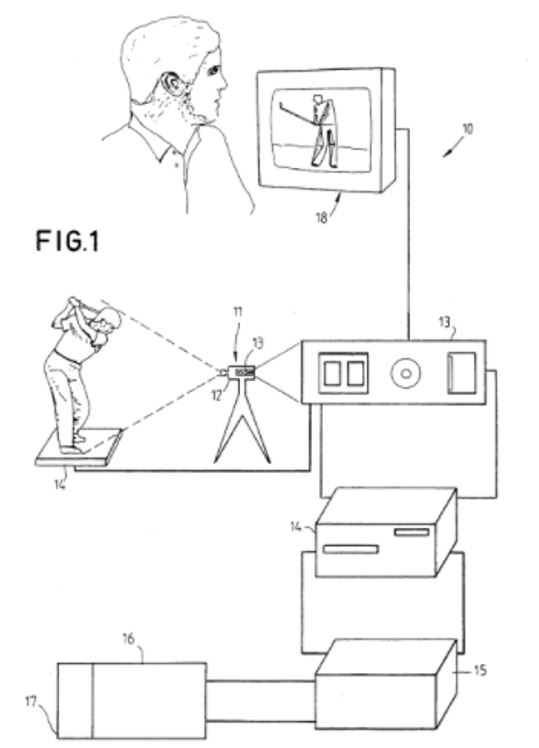
On April 9, 2018, the Federal Circuit ruled in favor of defendants Microsoft Corporation, Ubisoft, Inc., Nintendo of America, Inc., Electronic Arts Inc., Harmonix Music Systems, Inc., and Majesco Entertainment in a patent infringement suit brought by Australian individual Richard J. Baker.   The suit relates to Baker’s U.S. Patent No. 5,486,001, which relates to an instructional aid for movements.  The accused products included video games that incorporated an image capturing device (like a camera) connected to a gaming console or personal computer.


The ’001 Patent reads, in claim 1 and as amended during prosecution:
capturing and storing initial visual image signals representative of a particular movement at a first location,

storing preferred image signals representative of a selected preferred movement at a second location remote from said first location in a data base of a computer,

transmitting said captured and stored visual image signals from said first location to said computer at said second location,

. . .

transmitting said regenerated signals from said computer at said remote second location to said first location and stored in image presentation means which permits viewing thereof with dialogue relating to said regenerated visual secondary image signals.

The Federal Circuit affirmed the district court’s finding that “remote,” as used above, requires “more than physical separation at the same location.”  The Federal Circuit found that this amendment prevented infringement by any of the defendants, both literally and under the doctrine of equivalents.

Cases like these emphasize the importance of careful patent prosecution.  Per the Federal Circuit, the “first location” and “second limitation” language used above was added to traverse a reference (U.S. Patent No. 5,184,295 to Mann).  Little changes like these, which invoke the doctrine of prosecution history estoppel, can have significant ramifications during litigation, as demonstrated here.  It’s game over for Mr. Baker in this case.
    Home     Next >

Get the Patent Arcade App

Get the Patent Arcade App
Available now for iOS

Search This Blog


Recognition

Buy your copy today!

Buy your copy today!
ABA Legal Guide, 2d Ed.

Ross Dannenberg

Scott Kelly

Scott Kelly

Labels

Archives

Blogroll

Data Analytics

Copyright ©2005–present Ross Dannenberg. All rights reserved.
Visit BannerWitcoff.com