Visit BannerWitcoff.com
Showing posts with label Microsoft. Show all posts
U.S. Patent No. 7,803,048: Radar manipulation in a video game
Issued September 28, 2010, to Microsoft Corp.
Priority Date March 15, 2006


Summary:
U.S. Patent No. 7,803,048 (the '048 Patent) describes methods and systems for a deception in an online multiplayer game. One such method is for a player to manipulate the game's radar to trick other players. The player's in-game character could shoot a fake bullet to create a noise at another location, triggering the virtual acoustic radar. Also, a player can temporarily jam an opponent's radar, or make all the opponents visible on the radar. The '048 Patent describes several methods for deception using the in-game radar.

Abstract:
Methods and systems for deceiving other characters in a video game are disclosed. A video game may include a simulated environment in which player and computer controlled characters can monitor each other's positions using radar, e.g., an acoustic radar that detects noise (such as the firing of various weapons) associated with other characters. A character may fire a decoy bullet, which creates noise at the location of impact rather than the location of firing. A character may temporarily jam another character's radar so that the other character's radar does not display character locations. A first character may mimic an enemy character so that the first character appears as a friend to enemy characters on each enemy characters' radar. A special weapon may make all visible characters visually appear as enemies to a first character, thereby confusing the first character. Another special weapon may create a duplicate image of a character, thereby confusing others.
Illustrative Claim:
1. One or more computer readable storage device storing executable instructions for performing a video game method of representing characters on a radar image displayed on a video output device, said method comprising steps of: determining a first simulated noise level associated with a first object in a simulated environment operating under control of the video game; and displaying on the radar image, said radar image corresponding to a first character, a first radar blip corresponding to the first object, said first radar blip having a first characteristic based on the first simulated noise level associated with the first object determining a second simulated noise level associated with the first object in the simulated environment operating under control of the video game, wherein said second simulated noise level is determined to be louder than said first simulated noise level; and displaying on the radar image corresponding to the first character, a second radar blip corresponding to the first object, said second radar blip having a first characteristic based on the second simulated noise level associated with the first object, wherein the first characteristic of the first radar blip comprises a first amount of time based on the first simulated noise level, wherein the first characteristic of the second radar blip comprises a second amount of time based on the second simulated noise level, said second amount of time being longer than said first amount of time, wherein displaying the first radar blip comprises displaying the first radar blip for the first amount of time, and wherein displaying the second radar blip comprises displaying the second radar blip for the second amount of time.

Researched By: Andrew F. Thomas


U.S. Patent No. 7,663,045: Music replacement in a gaming system
Issued February 16, 2010, to Microsoft Corp.
Priority Date September 20, 2005


Summary:
U.S. Patent No. 7,663,045 (the '045 Patent) describes a method for a user to replace the background music in a video game with their music. The Xbox 360 allowed users to rip music from a CD and download it to the system's hard-drive. A benefit to having the music on the 360 hard-drive was the system allowed users to listen to their music while playing a game. The system would mute game's background music and then insert the user's music. If the game had a scripted moment that required preselected music, then the system would mute the user's music until the scripted moment finished.  Sound effects remained in the game, so effectively the 360 allowed users to create customized soundtracks.

Abstract:
A user of a game system can replace background music from a game with the user's selected background music, while still hearing any other audio streams (e.g. sound effects related to gameplay). A music engine and system audio mixer allow the playback of the user's requested replacement music. The game tags background music streams with an identifier indicating that they are background music, and such streams are muted at the music engine and system audio mixer (if the game is using the provided music engine in order to play the game's audio streams) or by the game if the game is using a game music engine and has received information indicating that a mute request has been issued.


Illustrative Claim:
1. A system for providing audio playback from a gaming system running an application, wherein said application generates an application default audio stream, said system comprising: application programming interfaces, said application programming interfaces integrating gaming system audio playback control features into said application, wherein audio commands issued by said application are implemented by said gaming system concurrently with execution of said application; an audio input for receiving said audio commands and said application default audio stream from said application; an audio replacement indicator for indicating when replacement of said application default audio stream is requested; an audio output, operably connected to said audio input and said audio replacement indicator, wherein said audio output plays audio comprising said application default audio stream if said audio replacement indicator indicates that no audio replacement is requested, or an alternate audio stream if said audio replacement indicator indicates that audio replacement is requested.


Researched By: Andrew F. Thomas


U.S. Patent No. 8,882,594: Control Scheme for real time strategy game
Issued November 11, 2014, to Microsoft Corp.
Priority Date April 5, 2007


Summary:

Real-time strategy games allow the player to command an army against imposing forces in real time. The player builds his army at the same time his opponent. The classic example of a real-time strategy game is StarCraft. Every movement in a real-time strategy game is crucial because time is a factor; wasteful motion can be the difference between winning and losing. Because time is such a factor, PC has dominated the real-time genre due to the flexibility and quickness of a mouse and keyboard offer. Traditionally, the cursor and screen position moved independently of each other. Early attempts at bringing real-time strategy kept the tradition control scheme, but cursor's movement speed on a console could not match the quickness of a PC mouse. U.S. Patent No. 8,882,594 (the '594 Patent) describes a control scheme for a real-time strategy game on a console that locks the cursor to a fix position in the center of the screen. When the player moves the cursor, the screen position also moves. The cursor always stayed in the center of the screen even if the player tilted the camera. By bolting the cursor to the center and moving the screen position instead, players could move and select units at a quicker pace. Also, the control scheme allowed for players to switch between different units using certain buttons. Microsoft used the '594 Patent's control scheme in the Halo Wars franchise.

Abstract:
A control scheme for a real time strategy game using a game controller includes maintaining a cursor in a known, fixed position of the monitor in a manner so that it appears the game space if moving behind a cursor even during changing viewing positions such as tilting movements. The control scheme further includes other aspects including a technique for selecting units using the game controller and interacting with menus using the game controller.

Illustrative Claim:

18. A system comprising: a processor; an input device having a user activated button; a rendering device; and a computer readable storage medium having instructions accessible by the processor and which when executed on the processor conduct a real time strategy game based on user input from the input device, the instructions comprising: operating a plurality of units of a plurality of different unit types in a game space, each of the units taking action in the game space based on corresponding instructions; determining a first user position relative to at least some units in the game space, the first user position being spaced apart from the units and having a parameter indicative of a first tilt with respect to the units; rendering a first view of a portion of the game space on the rendering device based on the first user position, the first view not corresponding to a view as seen by any of the units in the game space, the first view having the first tilt and including a cursor for selecting a unit, the cursor being at a known position relative to an edge of the rendered first view; receiving an indication of activation of the input device and, in response, identifying a set of the units based on the unit types; determining a second user position, with the processor, based on the identified set of the units, the second user position being spaced apart from the units and having a parameter indicative of a second tilt with respect to the units that is different than the first tilt; and for at least some of the execution of the game, rendering a second view of a portion of the game space based on the second user position, the second view having the second tilt and showing the identified set of units, while maintaining the cursor in the known position relative to the edge of the rendered view, the second view not corresponding to a view as seen by any of the units in the game space.


Researched By: Andrew F. Thomas


U.S. Patent No. 9,454,849: Augmented reality playspaces with adaptive game rules
Issued September 27, 2016, to Microsoft Technology Licensing, LLC


Summary:
U.S. Patent No. 9,454,849 (the ‘849 Patent) describes a method for generating a virtual gaming environment based on real-world objects. The patent describes a scenario where a player puts on an augmented reality head set and begins to travel around the real world. During the player’s travels, he may encounter monsters or puzzles which is generated by the headset. The headset will generate the monsters based on the real world environment surrounding the player. For example, a player in a forest is more likely to encounter a forest monster than an ocean monster. While wearing the headset, players will be able to interact with both real objects and virtual objects. Virtual objects will be created based on a variety of factors, including the real world environment.
Abstract:
A system for generating a virtual gaming environment based on features identified within a real-world environment, and adapting the virtual gaming environment over time as the features identified within the real-world environment change is described. Utilizing the technology described, a person wearing a head-mounted display device (HMD) may walk around a real-world environment and play a virtual game that is adapted to that real-world environment. For example, the HMD may identify environmental features within a real-world environment such as five grassy areas and two cars, and then spawn virtual monsters based on the location and type of the environmental features identified. The location and type of the environmental features identified may vary depending on the particular real-world environment in which the HMD exists and therefore each virtual game may look different depending on the particular real-world environment.
Illustrative Claim:
1. A method for generating an augmented reality environment, comprising: generating one or more virtual objects associated with a computing application using a mobile device, the one or more virtual objects include a first virtual object: identifying one or more real-world objects within a first real-world environment that are of a particular type; acquiring a computing application requirement that a particular number of real-world objects of the particular type be identified within the first real-world environment from the computing application; determining that a number of the one or more real-world objects identified within the first real-world environment of the particular type is not equal to the particular number of real-world objects required by the computing application; adjusting the one or more virtual objects in response to determining that the number of the one or more real-world objects identified within the first real-world environment of the particular type is not equal to the particular number of real-world objects required by the computing application, the one or more virtual objects include a first virtual object that moves within the augmented reality environment; detecting a particular sound using the mobile device; determining a distance between the first virtual object within the augmented reality environment and the mobile device; setting a degree of transparency for the first virtual object based on the distance between the first virtual object within the augmented reality environment and the mobile device in response to detecting the particular sound; generating one or more images associated with the first virtual object based on the degree of transparency; and displaying on the mobile device the one or more images, the one or more images are displayed such that the first virtual object is perceived to exist within the augmented reality environment.
Infernal Technology, LLC et al v. Crytek GmbH
United States District Court for the Eastern District of Texas
Docket No. 2-18-cv-00284, filed July 10, 2018

On July 10, 2018, Infernal Technology and Terminal Reality (Infernal) filed a lawsuit in the Eastern District of Texas alleging that Crytek GmbH (Crytek) infringed upon U.S. Patent Nos. 6,362,822 (the '822 Patent) and 7,061,488 (the '488 Patent). The two patents relate to lighting and shadowing methods in computer graphic simulations.

Image from the '822 Patent, Fig. 2.

Claim 1 of the '822 Patent reads:
A shadow rendering method for use in a computer system, the method comprising the steps of:

providing observer data of a simulated multi-dimensional scene;

providing lighting data associated with a plurality of simulated light sources arranged to illuminate said scene, said lighting data including light image data;

for each of said plurality of light sources, comparing at least a portion of said observer data with at least a portion of said light data to determine if a modeled point within storing at least a portion of said light image data associated with said point and said light source in a light accumulation buffer; and then

combining at least a portion of said light accumulation buffer with said observer data; and

displaying resulting image data to a computer screen. ('822 patent, col 12, lines 4-21).

Infernal claims that Crytek's utilization of video game engine "CryEngine" allegedly infringes the asserted patents. According to the Complaint, Crytek used the allegedly infringing game engine to develop the Crysis series, Warface, Ryse: Son of Rome, The Climb, and Robinson: The Journey.

Typically, the next step for a defendant in this situation is to petition the Patent Trial and Appeal Board (PTAB) for an Inter Partes Review (IPR), but the '822 and '488 Patents have already survived an IPR because of earlier litigation. In 2015, Infernal sued Electronic Arts for patent infringement. EA responded by petitioning the PTAB for an IPR; however, the PTAB found the '822 and '488 Patents to be "Not Unpatentable." EA settled the lawsuit after the PTAB's decision. Crytek can still petition for an IPR of the asserted patents, but will likely have to use different prior art that the art used by EA or provide a good reason why the Board got it wrong the first time around.

If this seems like deja vu that is because Infernal filed complaints similar to the Crytek Complaint against Microsoft in April and against Activision Blizzard in May. To read our blog post on the Microsoft case click here.  We will continue to monitor all three of these cases and provide updates when possible.
On May 15, 2018, the Patent Trial and Appeal Board (the “PTAB”) instituted two Inter Partes Review (“IPR”) proceedings against U.S. 5,822,523 (the “’523 Patent”).  The ’523 Patent generally relates to group messaging in interactive applications.  The petitioner is Riot Games, Inc. (“Riot Games”), maker of popular titles like League of Legends The patent owner is Paltalk Holdings, Inc. (“Paltalk”).  From 2006-2009, the ’523 Patent was asserted by Paltalk in patent infringement cases against Microsoft, Sony, Activision Blizzard, NCsoft, Jagex, and Turbine Inc., among others.


Claim 1 of the ’523 Patent reads:
1. A method for providing group messages to a plurality of host computers connected over a unicast wide area communication network, comprising the steps of:

   providing a group messaging server coupled to said network, said server communicating with said plurality of host computers using said unicast network and maintaining a list of message groups, each message group containing at least one host computer;

   sending, by a plurality of host computers belonging to a first message group, messages to said server via said unicast network, said messages containing a payload portion and a portion for identifying said first message group;

   aggregating, by said server in a time interval determined in accordance with a predefined criterion, said payload portions of said messages to create an aggregated payload;

   forming an aggregated message using said aggregated payload; and

   transmitting, by said server via said unicast network, said aggregated message to a recipient host computer belonging to said first message group.
Both Riot Games and Paltalk agree that the ’523 Patent expired.  While it might seem strange for Riot Games to attack the validity of an expired patent, a patent owner may sue for damages that were incurred when their now-expired patent was valid, though they cannot recover damages that were incurred more than six years prior to the filing of the lawsuit.  As it appears that the ’523 Patent expired in 2016, Paltalk could potentially file patent infringement lawsuits up until around 2022, but only for damages that they incurred prior to 2016, and only so long as their damages were in the six years before they filed the lawsuits.  For example, if Paltalk sued a game company for patent infringement on Jan. 1, 2021, they could recover damages from Jan. 1, 2015, up until the date the ’523 Patent expired in 2016.
On April 11, 2018, Infernal Technology, LLC and Terminal Reality, Inc. (“Infernal”) filed a complaint for patent infringement against Microsoft Corporation (“Microsoft”).  The asserted patents, U.S. 6,362,822 and U.S. 7,061,488, relate to lighting and shadowing methods for graphics simulation. According to Infernal, both patents have already survived an Inter Partes Review challenge filed by Electronic Arts in 2016.


According to the complaint, Terminal Reality was the developer of games such as Nocturne, Bloodrayne, Ghostbusters: The Video Game, Kinect Star Wars, The Walking Dead: Survival Instinct.  As part of their game development work, Terminal Reality developed a graphics engine (“Infernal Engine”).  Infernal Technology has an exclusive license to patents related to the Infernal Engine, including those asserted against Microsoft.

Infernal alleges that games developed by Microsoft on the Unreal Engine 4, CryEngine 3, CryEngine 4, Alan Wake Engine, Renderware Engine, Forge Engine Forzatech Engine, Northlight Engine, Unity Engine, Foundation Engine, Halo 4 Engine, Halo 5: Guardians Engine, and Halo: Reach Engine infringe the asserted patents.  These allegations seem to include the lions’ share of games on Microsoft’s consoles, including but not limited to Alan Wake, Crackdown, Crackdown 2, Crackdown 3, Dead Rising 3, Fable Legends, Forza Motorsport 6, Forza Motorsport 7, Gears of War 4, Halo 4, Halo 5: Guardians, Halo: Reach, Kalimba, Ori and the Blind Forest, PlayerUnknown’s Battlegrounds, Quantum Break, ReCore, Rise of the Tomb Raider, Ryse: Son of Rome, Sea of Thieves, State of Decay, and Super Lucky’s Tale.

Interestingly, Infernal’s case was filed in the Eastern District of Texas.  While that venue was once a hotbed of patent litigation, in TC Heartland LLC v. Kraft Foods Grp. Brands LLC, 137 S. Ct. 1514 (2017), the Supreme Court limited venue in patent infringement actions to where (1) the defendant resides, or (2) the defendant has committed acts of infringement and has a regular and established place of business.  This ruling has generally been seen as a significant limitation on bringing cases in the Eastern District of Texas.  Nonetheless, Infernal alleges that Microsoft is a resident of the State of Texas, has a designated agent for service of process in the State of Texas, and has committed acts of infringement in the State of Texas.  Whether the facts underlying these assertions are sufficient for venue in the Eastern District of Texas after TC Heartland remains to be seen.

We will monitor this case and keep our readers informed of any updates.
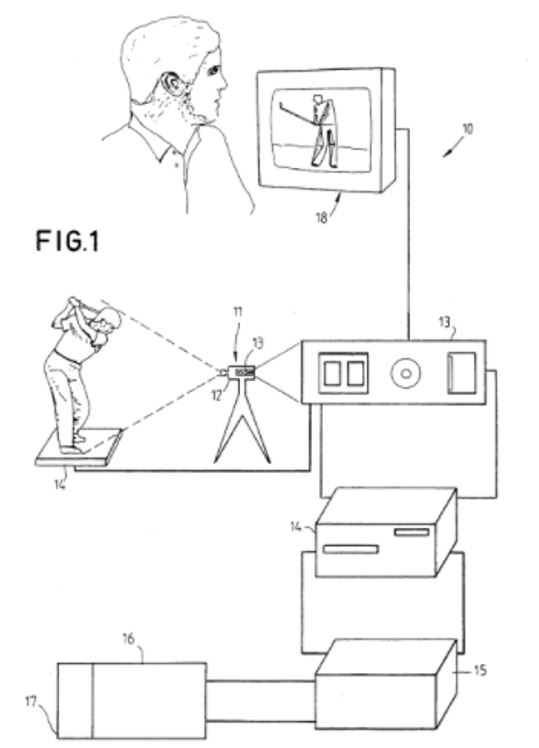
On April 9, 2018, the Federal Circuit ruled in favor of defendants Microsoft Corporation, Ubisoft, Inc., Nintendo of America, Inc., Electronic Arts Inc., Harmonix Music Systems, Inc., and Majesco Entertainment in a patent infringement suit brought by Australian individual Richard J. Baker.   The suit relates to Baker’s U.S. Patent No. 5,486,001, which relates to an instructional aid for movements.  The accused products included video games that incorporated an image capturing device (like a camera) connected to a gaming console or personal computer.


The ’001 Patent reads, in claim 1 and as amended during prosecution:
capturing and storing initial visual image signals representative of a particular movement at a first location,

storing preferred image signals representative of a selected preferred movement at a second location remote from said first location in a data base of a computer,

transmitting said captured and stored visual image signals from said first location to said computer at said second location,

. . .

transmitting said regenerated signals from said computer at said remote second location to said first location and stored in image presentation means which permits viewing thereof with dialogue relating to said regenerated visual secondary image signals.

The Federal Circuit affirmed the district court’s finding that “remote,” as used above, requires “more than physical separation at the same location.”  The Federal Circuit found that this amendment prevented infringement by any of the defendants, both literally and under the doctrine of equivalents.

Cases like these emphasize the importance of careful patent prosecution.  Per the Federal Circuit, the “first location” and “second limitation” language used above was added to traverse a reference (U.S. Patent No. 5,184,295 to Mann).  Little changes like these, which invoke the doctrine of prosecution history estoppel, can have significant ramifications during litigation, as demonstrated here.  It’s game over for Mr. Baker in this case.
U.S. Patent No. 8,491,394: Squad vs. squad video game
Issued Jul. 23, 2013, to Microsoft Corporation


Summary:

The ‘394 patent applies to shooter video games, which are focused around competing squads. The patent covers both games in which a single player controls each squad and more than one player controls each squad. The game receives inputs from the controlling players about squad actions and communicates these actions to other systems in the game. The patent also covers the player’s ability to join or leave his or her squad at any point during gameplay without ending the game.


Abstract:

A squad versus squad shooter video game receives input from one or more players via their respective use of controllers in communication with one or more console-based video game systems. The input from each controller is interpreted as a command to a squad in a competition against one or more other squads that are respectively commanded by one or more players via their respective use of controllers. Each squad includes a plurality of characters. Each player is assigned to one of the squads. Actions of each character in the video game are a function of commands given to that character by one of the players. Players can join or exit their assigned squad during game play.


Illustrative Claim:

1. A method comprising:
facilitating play of a game title by one or more players commanding, via their respective use of controllers, a squad in a competition against one or more other squads that are respectively commanded by one or more players via their respective use of controllers, wherein:
each said squad includes a plurality of characters;
each said player is assigned to one said squad;
each said squad has at least one said player assigned thereto; and
action of each said character in the play of the game title is a function of a command given to that character by one said player;
detecting, while any said player is playing the game title, a join condition indicating that a new player would like to join in playing the game title; and
in response to the join condition, assigning a new squad to the new player when it is determined that the new player is to form the new squad.

ADC Technology v. Microsoft et. al.
United States District Court for the Western District of Washington
Case No.: 2:08-cv-10579; filed October 27, 2008.

ADC had brought suit against Microsoft and Nintendo (Sony was originally included, but has since been dismissed without prejudice) claiming infringement of its patents for pay-for-download software over a computer network, including videogames.  The case is currently stayed until reexamination requests are completed.  ADC is providing bi-annual status updates until these reexaminations are complete.

We will continue to monitor this case and update accordingly.
Microsoft Corporation v Datel Design and Development Inc., et al
U.S. District Court, Western District of Washington
Case No. 2:2010cv02065, Filed On December 23, 2010

During December of 2011, a settlement was reached in an antitrust and patent infringement dispute between Microsoft and Datel Design and Development Ltd that began in 2009.  To summarize the details of this battle covered partially in a previous post, Microsoft implemented an update to its Xbox 360 system that prevented Datel’s memory cards from working with the console.  Datel sued Microsoft in 2009, claiming that Microsoft’s actions were anticompetitive and in violation of federal antitrust law.  In 2010, Microsoft initiated a lawsuit of its own against Datel, claiming that Datel’s Turbofire and WildFire Xbox 360 controllers infringed its patent that covers the communication between a gaming console and a wireless accessory (U.S. Patent No. 7,787,411).  Datel agreed to stop manufacturing and importing the offending devices, however Microsoft still sought compensatory damages from past infringement despite dropping the infringement case.  Finally, in December of 2011, Microsoft and Datel reached a confidential settlement agreement out of court, ending the 2 year antitrust and infringement litigation. 

Microsoft has acquired Twisted Pixel Studios, according to a recent Microsoft press release:
As a step in continuing to deliver Microsoft Studios’ innovative game and entertainment offerings, Microsoft has announced the acquisition of Austin, Texas-based game developer Twisted Pixel, the creative minds behind Xbox LIVE Arcade titles such as “Splosion Man” and the recent Kinect for Xbox 360 title, “The Gunstringer.”
Twisted Pixel joins other globally-recognized game creators such as Lionhead Studios and Rare Ltd who have also been acquired by Microsoft.
Ads on Xbox

As advertising continues to evolve for game platforms, the New York Times reports that Microsoft is set to launch a new suite of advertising tools called NUads (short for natural user interface ads) on the Xbox Kinect gaming consoles.

Developments at the USPTO earlier this month indicated that Microsoft had plans for a new, interactive advertising platform utilizing the Xbox 360 Kinect camera controller. On June 6, 2011, Microsoft filed a trademark application for the term “NUADS” for “advertising services, namely, promoting and marketing the goods and services of others through online interactive video games by enabling consumers to interact with third-party advertising content through voice or body gestures via computer game console and sensor devices.” See full trademark application here.

Both Gamasutra and Techie Buzz speculated that this could be the natural user interface that Microsoft had been talking about for quite a while, which would allow them to offer a similar service to iAds, the Apple advertising platform for app developers to create apps/ads that offer an interactive and aesthetically pleasing experience for the user. According to the Times, NUAds will allow Xbox users to use voice and motion commands to interact with advertisements while they are playing games or watching videos.

The NUAds will be located on the console dashboard, embedded in games and other video content. They are intended to help advertisers keep the attention of Xbox users in a way traditional television advertising does not by creating a way for users to interact and engage with their televisions. Using voice commands, gamers will also be able to send messages about ads to networking sites like Twitter, to text messages about ads, or to vote as part of promotions.

These new advertising options will be presented today (June 21, 2011) to advertisers at the Cannes Lions International Festival of Creativity, an annual conference for advertisers and marketers.

    Home     Next >

Get the Patent Arcade App

Get the Patent Arcade App
Available now for iOS

Search This Blog


Recognition

Buy your copy today!

Buy your copy today!
ABA Legal Guide, 2d Ed.

Ross Dannenberg

Scott Kelly

Scott Kelly

Labels

Archives

Blogroll

Data Analytics

Copyright ©2005–present Ross Dannenberg. All rights reserved.
Visit BannerWitcoff.com